Speed is surprisingly counterproductive if you’re headed in the wrong direction. Yet we blindly worship action. You should ship fast, sell fast, spend fast. Swift decisions win you budget and promotions. Slowing down to think things through gets you labeled “lazy” or “low horsepower”.
We’ve accidentally turned speed into a broken proxy for productivity.
Our brain chemistry reinforces these misaligned incentives by rewarding action with dopamine. A rush of motivation, excitement, and pleasure convinces us any action is better than inaction, regardless of whether it was the right one.
When this impulsive behavior takes hold across an entire organization, you don’t just lose efficiency. You’re building a system that generates expensive mistakes at scale.
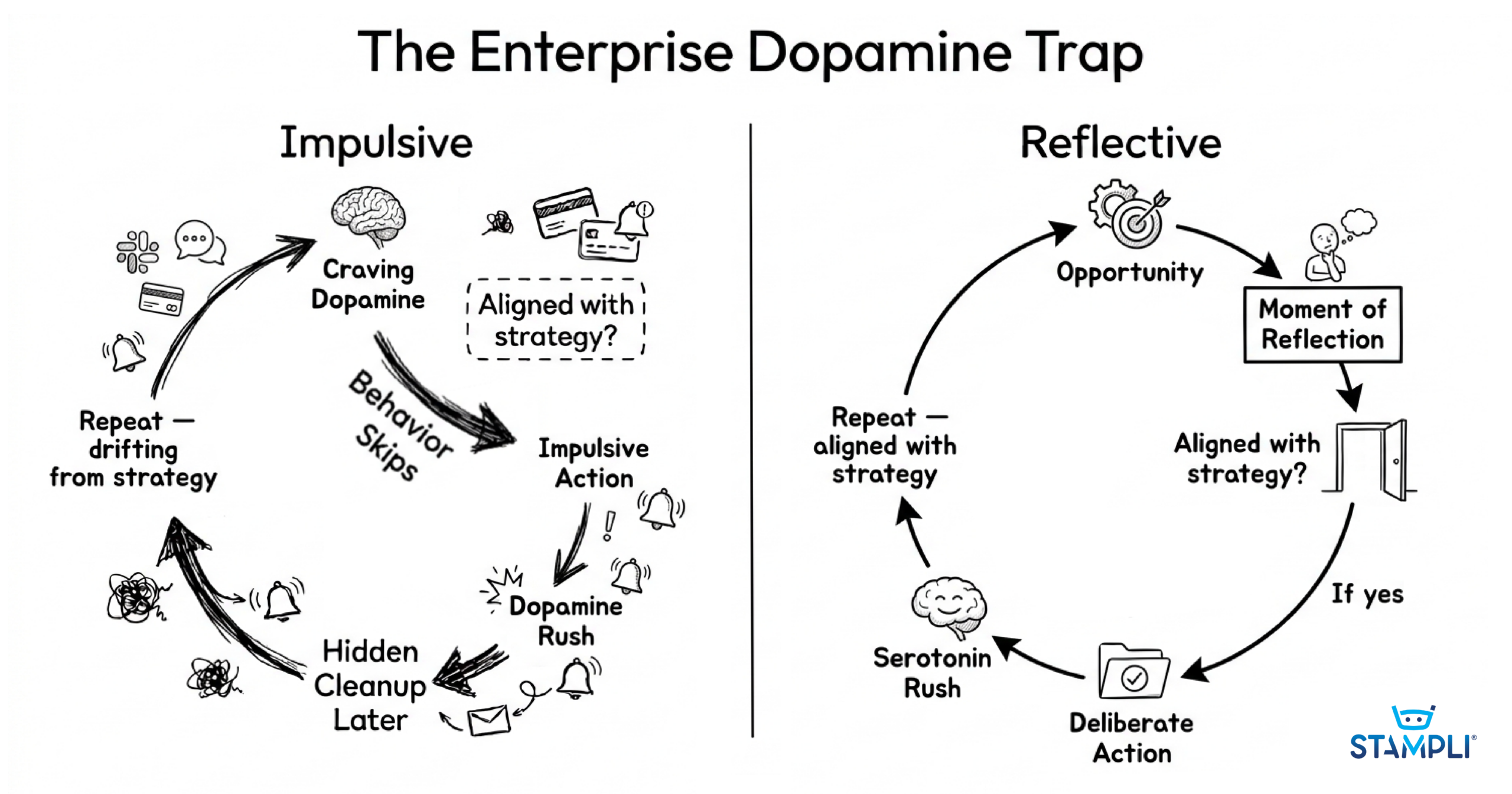
I call this the Enterprise Dopamine Trap. And the more I talk to leaders in finance and other functions, the more I’m convinced it’s one of the most under-diagnosed but solvable problems in modern business. It just requires reflection.
You’re Already Addicted to the Dopamine Trap
Before we talk about how this emerges within and destroys enterprises, consider how familiar this pattern already is in your personal life.
Doomscrolling: You open your phone to check one thing. Twenty minutes later, you’ve consumed dozens of posts, none of which you can recall. The scroll itself was the reward. Your brain registered “activity” even though nothing of value was accomplished.
Retail therapy: You buy something online not because you need it, but because the act of buying feels good. The one-click checkout, the confirmation screen, the shipping notification. Each one delivers a small dopamine hit as you anticipate the delivery. The product itself was almost beside the point.
Stanford research on the neural predictors of purchases showed that when purchases become frictionless like with Apple Pay, the brain’s natural “pain of paying” signal (the mechanism that makes you pause and ask “do I really need this?”) gets suppressed. You don’t hand over money, so you’re fooled into thinking you got something for nothing. That leads you to spend more, not because you want more, but because technology removed the cue to stop.
The same neurological pattern is playing out every day inside your company. In fact, your tools were purposefully designed to earn their creators money by encouraging reckless decisions.
What is the Enterprise Dopamine Trap?
Dopamine doesn’t just reward pleasure. It trains future behavior. When we complete a task quickly and feel that small hit of satisfaction, our brain files that action under “do this again.” The faster the feedback, the stronger the trap.
According to Wolfram Schultz’s foundational neuroscience research, dopamine doesn’t just come from actually receiving rewards. It’s released upon the expectation of rewards. In one experiment, monkeys experienced dopamine rushes when given juice at random. But when experimenters consistently flashed a light before administering the juice, it retrained the monkeys’ brains to release dopamine when the light flashed instead of when they received the reward.
This has a direct implication for the workplace: systems that consistently reward quick completion literally condition employees to prioritize speed over correctness.
The dopamine system, and the credit card company earning fees on every swipe, don’t care whether your purchase order went through the proper requisition process. They care that you finished the task and moved on, further entrenching the behavior.
The irony is that optimizing for speed doesn’t even deliver sustained performance. According to Dr. Anna Lembke, Stanford psychiatrist and author of Dopamine Nation, repeated “cheap dopamine,” the kind that comes from rapid, low-effort task completion, actually depletes the reward system over time. The result isn’t sustained performance. It’s burnout. And that’s made worse by all the backtracking and cleanup needed to fix the bad decisions.
That’s why it’s on managers to recognize these where enterprise dopamine traps are emerging, and break the cycle.
Examples of Dopamine Traps in Business
In your personal life, the consequences of dopamine misalignment are limited. You waste some time scrolling. You return a sweater. The damage is contained.
But in an enterprise, the same trap operates at a completely different scale, and with far less visibility and few chances to undo decisions. Here’s what this looks like:
1. The Swipe Before the Ask
An employee needs software for a project. Instead of submitting a purchase request (which would require thinking through the budget, validating the need, and getting the right approval) they pull out a corporate card and *ding*. It’s done in seconds and feels like it’s moving a project forward.
But what actually happened?
- A financial commitment was made with no upstream alignment.
- No one checked whether the tool duplicates something the company already has.
- No one validated the vendor or confirmed the general ledger coding.
- Someone in accounts payable will now have to reconcile it later, often without the context needed to code it correctly.
There’s a reason why banks make it so easy to provision new cards. MIT’s research shows that corporate cards extend frictionless impulse payments from consumer into much higher-stakes enterprise spend.
2. Slack Responsiveness as Fake Productivity
Teams increasingly equate responsiveness in Slack with productivity. The faster you reply, the more engaged and helpful you appear.
But rapid-fire messaging often displaces the deep, focused work that actually drives outcomes. You feel busy. Your manager sees you’re active. But the high-value task, the one that requires concentration, judgment, and synthesis, keeps getting deferred.
Slack wants its green ‘Active’ dot to be your measure of productivity. But the dopamine trap of instant messaging is actively competing with the work that matters most.
3. SaaS and Cloud Sprawl
Free trials that auto-convert. Cloud services spun up for a POC and never shut down. Departmental SaaS subscriptions that nobody audits because the monthly cost seems small.
Individually, each one was a “fast” decision. Collectively, they become uncontrolled recurring spend that finance discovers only at close, or worse, during an audit. The ease of starting these commitments is the problem. The pain of unwinding them is what drags down the company. But if you implement a rigid, cumbersome procurement system, your team might just go rogue and bypass it entirely.
Across all of these, the common thread is the same: the “ask” has been engineered out.
It’s when someone pauses to articulate why they need something, who should approve it, and whether it aligns with the organization’s goals. That moment has been treated as friction to be eliminated. In its absence, the dopamine reward trap takes over.
But while the tightrope between too much red tape and too little deliberation is thin, it is walkable.
The Fix: A Moment of Reflection Before Irreversible Decisions
Breaking the enterprise dopamine reward trap doesn’t require slowing everything down. It doesn’t mean adding layers of bureaucracy or returning to paper-based approvals.
It means building one thing back into the process that modern tools have removed: a moment of reflection before an irreversible decision.
A moment of reflection is a structured pause, not a bottleneck, that ensures the person making a commitment has considered whether that commitment is aligned with the organization’s actual purpose. It’s the difference between:
- “I can buy this” → action without alignment
- “Should I buy this, and do the right people agree?” → action with purpose
When you design systems that reward alignment and correctness rather than raw speed, you build an upward spiral of stronger and stronger strategy.
Finance teams that operate with reflection aren’t slower. They’re more decisive, because each decision carries context and moves the organization forward without creating hidden costs later.
Building Moments of Reflection Into Your Business
While the problem is omnipresent across business functions, let’s look at how to implement the moment of reflection across three critical procure-to-pay decisions.
Intake Before Commitment (Procurement)
In procurement, reflection means capturing the request before the purchase.
A proper intake process ensures that before a commitment, the organization knows:
- What’s being purchased and why it’s needed
- Whether it’s been budgeted
- Who has the authority to approve it
This is where the “ask” lives. Without it, procurement becomes reactive, chasing down context after the fact instead of guiding decisions before they’re made.
Intent Before Volume (Corporate Cards)
For corporate card programs, reflection means establishing intent before the transaction, not reconciling after it.
When an employee swipes a card, the organization should already have context, including:
- A linked purchase request
- A budget allocation
- An approved purpose
The card should be a payment mechanism, not a decision-making tool, because a credit limit isn’t a budget. This isn’t about restricting employees. It’s about ensuring that by the time the card is used, the alignment has already happened.
Validated Against ERP Rules Before Posting (Payments & AP)
At the payments and AP layer, reflection means that no transaction posts to the ERP without being validated against the organization’s own rules:
- Correct GL coding
- Right approver in the chain
- Matching against purchase orders
- Compliance with audit standards
This is the final control layer, and it’s where accuracy and audit readiness live. When validation happens before posting rather than as a correction after, the close is faster, exceptions are fewer, and the audit is cleaner.
Where AI Fits, and Where it Doesn’t
Someone will surely argue that AI will solve the problem by automating away all the decisions. I want to be direct: that’s not what I believe, and it’s not how we’ve built Stampli.
AI is extraordinarily good at handling permutations, like the high-volume, repetitive, pattern-recognition work that drains finance teams:
- Matching invoices to POs
- Suggesting GL codes based on historical patterns
- Flagging exceptions that don’t conform to established rules
- Routing transactions to the right approver
Freeing finance teams from this low-signal work is exactly how you protect their capacity for the work that matters.
But financial judgment stays with the team.
The choices about what your policies are, whether spend is strategically justified, or whether an exception should be approved should remain human decisions. AI handles the permutations. People keep the judgment. That’s the guardrail, and it’s non-negotiable.
It’s also what keeps talented teams motivated long-term. Dr. Lembke found that durable fulfillment comes not from the elimination of effort, but from the redirection of effort toward high-signal work. When AI automates the repetitive data entry and pattern matching, finance professionals can invest their cognitive energy in strategic exceptions and decision quality. That’s the work that produces real satisfaction and real outcomes.
A Leadership Challenge: Reward Alignment, Not Speed
If the enterprise dopamine reward trap is a systemic problem, it requires a systemic response. And that response starts with leadership.
Today, most organizations implicitly reward volume: the number of invoices processed, the speed of approvals, the throughput of transactions. These metrics feel objective and measurable. But they measure motion, not quality. They tell you how fast your team is going, not whether they’re going in the right direction.
The shift I’m proposing is straightforward. Give your teams time to reflect on decisions, and start incentivizing alignment:
- Reward the team that catches the coding error before it posts.
- Recognize the approver who asks the clarifying question before rubber-stamping.
- Celebrate the procurement process that prevents rogue spend before it happens, rather than the AP team that heroically cleans it up.
With the right tools and a culture of reflection, you can turn decision quality into your strategic advantage
Want stress-free finance tools that bring reflection to your procure-to-pay process? Use Stampli.
Stampli runs Procurement, Accounts Payable, and Payments in a single system. Stampli’s AI does the work, your ERP rules validate every transaction, and your team retains the strategic judgments. See how it works.