A Guide to an Automated Accounts Payable Process

Excessive paper can plague accounts payable departments.
Take a mid-size or enterprise level company that receives more than 1,000 invoices a month, or even a small business with a substantial number of vendors and paper use can easily multiply during processing. Invoices should get grouped with purchase orders and receipt reports, at a minimum and if invoice exceptions or issues generate a flurry of emails, the paper trail can lengthen further. It’s no surprise that in a survey of the biggest AP headaches for a 2021 whitepaper, excessive paper tied for second.
It’s possible to get beyond this, though. Today we’re going to look at what’s needed to implement a paperless accounts payable process with the help of AP automation software. We’ll explore what it takes to get to paperless zen.
Three Reasons It Pays to Go Paperless

A lot of organizations might try to stick with paper-based accounting practices. Here are three reasons to opt for a paperless accounts payable process instead.
1. A Paperless Accounts Payable Process Fits AP’s Evolution
The COVID-19 pandemic upended normal business operations, with 58% of workers saying in an October 2020 Gallup poll that they were working remotely at least some of the time. And even before the pandemic, accounts payable work had been evolving.
Long gone are the days where AP clerks just cut checks and performed monthly reconciliations. Today, AP teams can work both collaboratively and in a variety of locations. An AP clerk might prepare an invoice for payment at their desk in Mountain View, Calif. and then seek approval from a CFO at a conference (or home office) in Denver.
In a paper-based process, invoices can sit on desks for weeks, waiting until a higher-up can return to the office and grant approval. And the pile might grow, too, with 54% of companies in a 2021 survey by Stampli and Treasury Webinars, “AP Today: Bottlenecks, Benchmarks & Best Practices” noting that they process more than 500 invoices a month.
With a paperless accounts payable process, though, invoices can route directly to approvers wherever they are or to their designated backup with the help of customizable workflows.
2. Going Paperless Gets Results
Organizations reluctant to invest in AP automation might try to go a la carte, whether with document management software, invoice scanning, or other limited tools that handle a small part of the AP process. But as officials in Spanish Fork, Utah found, going a la carte has a downside.
“We went three months with another software, and it was a struggle every moment,” a city official told Government Technology. “We never really got to process one invoice after three months.”
As Spanish Fork learned, it’s better to use AP automation software to go fully paperless. There are all sorts of benefits to doing this. In a 2021 survey report from Stampli and Treasury Webinars, “The How, the Why & the ROI of AP Automation” 57% of respondents reported faster invoice approval, 44% saw a reduction in paper volume, and 37% saw increased employee productivity.
3. A Paperless Accounts Payable Process Makes Early Payment Discounts More Attainable
Many vendors are willing to extend 2% to 3% early payment discounts, which can lead to sizable savings over the course of hundreds or thousands of invoices. Somehow, most companies miss these discounts, with 23% of companies surveyed in “Common Invoice Problems: How to Deal With Them” admitting that they had.
Part of the problem is that paper-based accounts payable practices can severely bog things down. It’s easy for an AP clerk to miss a discount, or even incur a late charge from a vendor when they’re drowning in paper.
On the other hand, AP automation software can make it easier for organizations to receive early payment discounts, given the boosts in productivity it allows for. As a member of Spanish Fork’s AP staff told Government Technology, “What used to take up to 12 hours can now be done in about one hour.”
Factors to Consider when Going Paperless: Cost, Implementation, and Security
Good AP automation system providers can help companies overcome hurdles. These include the following:
Cost
One vendor noted a few years ago that AP automation software might run $20,000 to $35,000 to implement. That could give sticker shock to many companies at a time where unemployment has been close to or above 10% in parts of the country in recent months, according to the United States Bureau of Labor Statistics.
It might seem smart during tough economic times to stick with paying paper invoices, since it theoretically doesn’t cost anything to do this. That said, a paperless accounts payable processing system can more than pay for itself in short order.
How a good system handles cost: While paper invoices technically don’t have processing costs, an Institute of Finance and Management (IOFM) benchmarking study found that they can cost five times as much as electronic invoices to process.
Factoring in staffing time and other costs, a company might only need to process around 2,500 invoices to recoup the cost of a basic automated system. Many companies will process this many invoices in the space of a few months. In other words, AP automation systems that enable paperless accounts payable processes can effectively mint money for companies.
Implementation
For companies with years of paper invoices on-file and staff who might be reluctant to learn how to use new software, implementing a paperless accounts payable process probably sounds like a nightmare with no guarantee to work.
That said, implementation shouldn’t be any hindrance whatsoever for getting an AP automation system up and running.
How a good system handles implementation: Stampli can implement an easy-to-use, paperless accounts payable process in a matter of days. And once it’s in place, dedicated customer service reps are available to ensure that everyone can have an optimal experience with the software.
Security
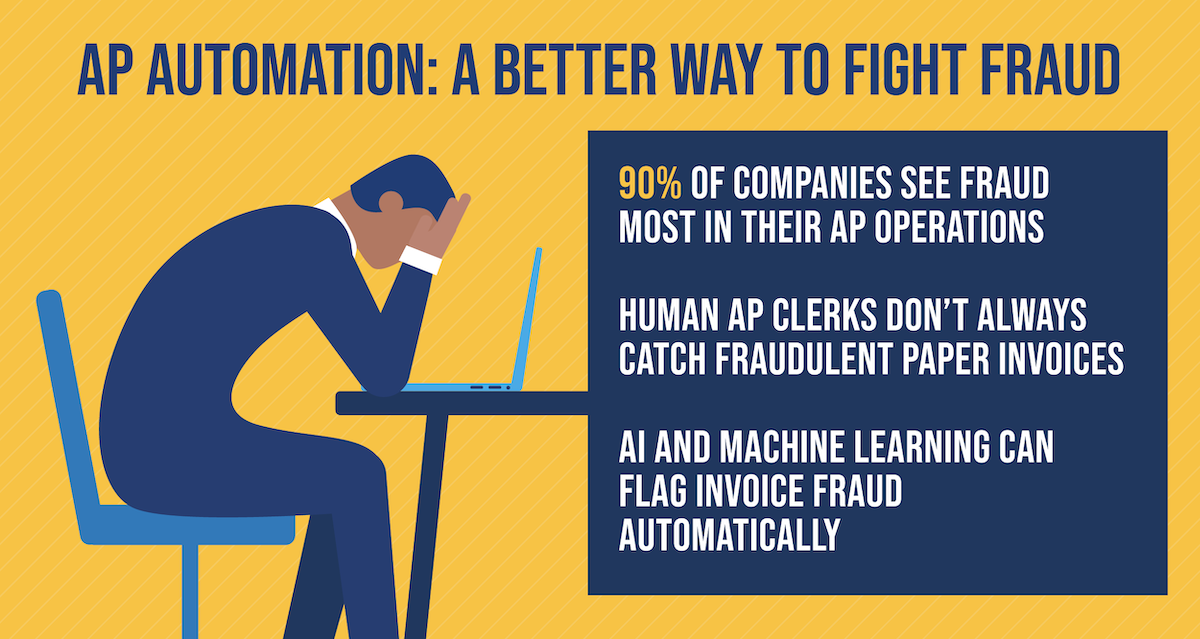
Countless hacking schemes in recent years show that web security is one of the greatest challenges facing businesses these days. And COVID-19 only made these challenges more pronounced, with phishing attacks rising 66.7%, as PICPA noted in November 2020. Seeing as 90% of companies have seen fraud most in their AP operations, it stands to reason that AP is under greater threat than ever with the pandemic.
The good news is that a paperless accounts payable process with the help of automation is actually far safer than paper-based processes.
How a good system handles security: Top-flight paperless accounts payable process providers make sure to have systems with built-in security features such as encryption and two-factor authentication, making it tougher for bad actors to circumvent them. The systems can also automatically flag fraudulent invoices that might slip past the eye of even a well-trained AP clerk if they’re just processed in paper form.
How Stampli Helps Companies Achieve a Paperless Accounts Payable Process
For companies that have decided to implement a paperless accounts payable process, here are a few ways Stampli can help make it happen.
We Can Engage Your Entire Team
One of the things that can keep companies stuck in paper-based accounting practices can be reluctance from higher-ups or fear that rank-and-file accounting staff might not be able to learn a new automation system.
That’s where Stampli comes in. We can help guide companies toward a system that will meet their needs and give them an idea of what to expect through the implementation process. We can also help get all internal stakeholders on the same page and provide them the necessary training and materials so that they’ll know how to use the new system from Day 1.
Good AP automation solutions like Stampli can help make sure high-level teamwork occurs. We know that without it, the zen of a paperless accounts payable process will remain elusive.
We Can Easily Integrate Your Documentation and Records
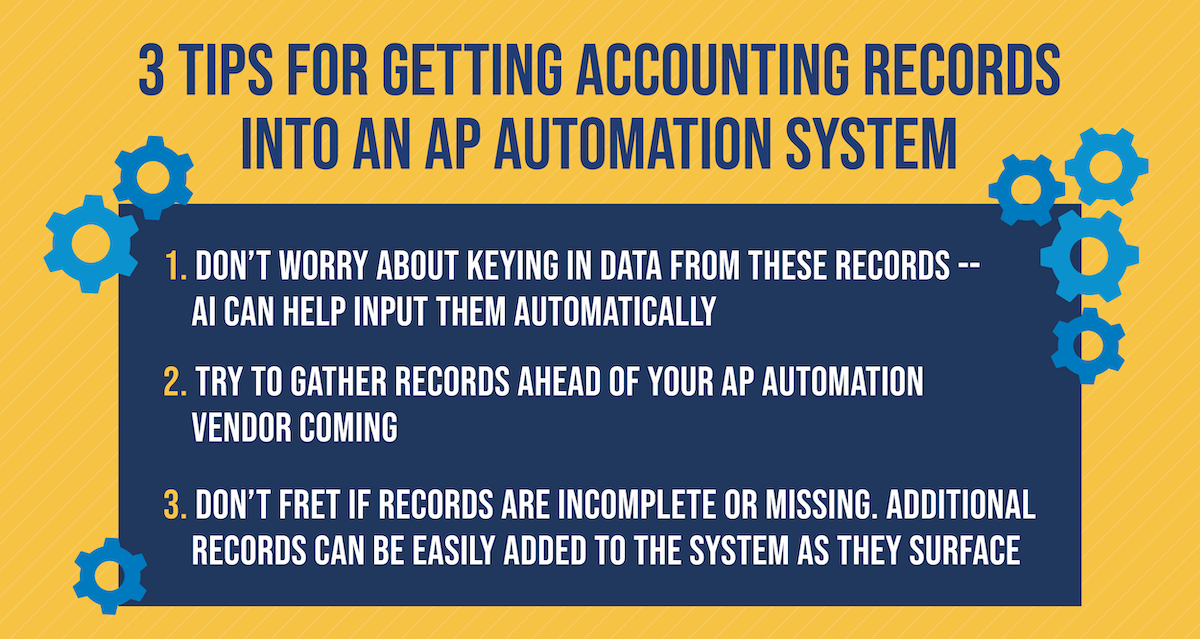
One of the nice things about getting an AP automation system? It doesn’t negate all the years of paper records, which can be easily scanned into the new system with the help of tools like optical character recognition, or OCR software. After all, a paperless accounts payable process doesn’t mean all those important records stop having meaning.
At Stampli, we can help the companies we work with gather all of their records together ahead of the implementation. With the help of our scanning and artificial intelligence tools, we can ensure that all of these records make it seamlessly into your new AP automation system.
We’ll Make You Wonder Why You Tolerated Paper For So Long
End of the day, paper doesn’t remain ubiquitous for so many accounts payable departments because it makes the most business sense. It’s just the way things have been done for a long time, some companies can be averse to change, and implementing an AP automation solution might sound tougher than it is.
With Stampli, though, we make achieving a paperless accounts payable process a breeze. We’ll help the companies we work with achieve paperless zen before they know it.
Stamps are for old paper invoices. Stampli’s for the future of accounts payable. Come see the difference today.
