1099 Season Exposes the Accounts Payable Process Gaps You’ve Been Living With All Year
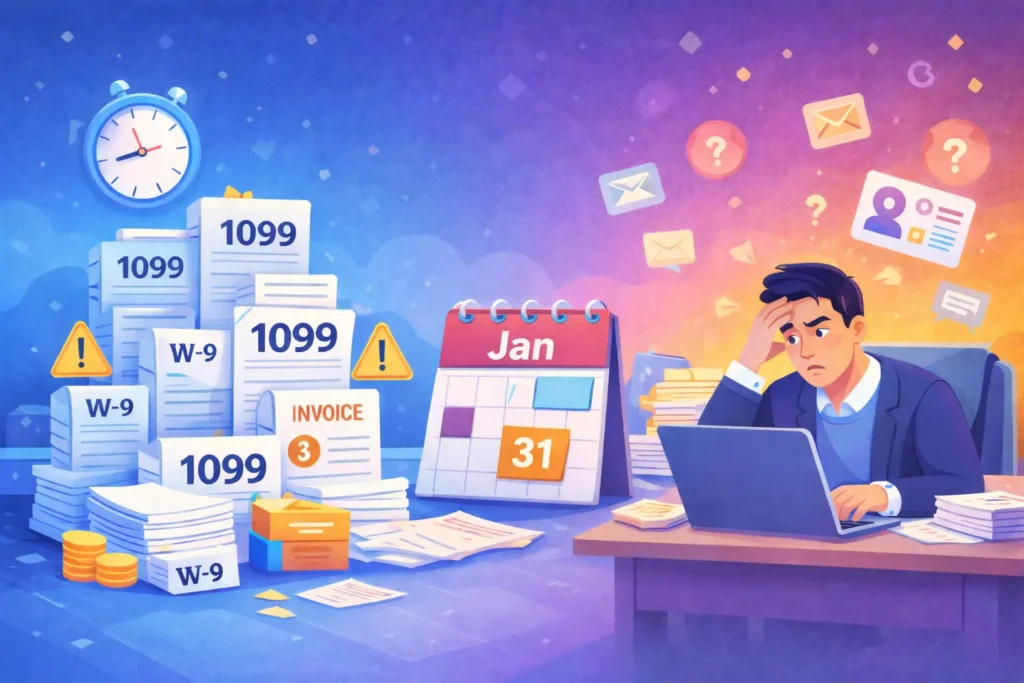
It’s the last week of January. Your 1099 deadline is in days. And your calendar for the week? Blocked. Vendor calls pushed to February. Strategic projects on hold. The only priority is getting through the compliance gauntlet.
Every January, 1099 accounts payable work consumes entire teams—chasing down W-9s, reconciling vendor data, hunting through email threads for documentation that should have been captured months ago. The 1099 deadline doesn’t create these problems. The real issue is disconnection: purchase requests, approvals, invoices, and vendor data live in different silos. Teams lose visibility and control throughout the year, then have to reconstruct decisions under deadline pressure.
Here’s what nobody tells you: People think they need better 1099 tools. What they actually need is confidence in the data their AP process produced all year.
Your ERP records what happened. It doesn’t capture why—the approvals, the conversations, the judgment calls. That context lives elsewhere, if it’s captured at all. And when it’s scattered across inboxes and spreadsheets, you’re not running a process. You’re relying on memory.
The Real 1099 Problem in Accounts Payable? Non-PO Invoices
In conversations with AP managers at mid-market organizations, a pattern emerges. One shared that roughly 75% of their invoices have a purchase order or blanket PO attached. Utility bills, taxes, travel reimbursements—they don’t.
That remaining 25%? That’s where the pain lives.
Most organizations run 20–30% of their spend through non-PO invoices. These are exception-heavy by nature. They’re manually coded. They’re routed via email. They don’t have the clean audit trail that PO-backed transactions provide.
And critically, this is where 1099 errors hide.
When an invoice comes in without a purchase order, someone has to decide how to code it. Someone has to approve it. Someone has to determine if the vendor should be flagged for 1099 reporting. Those decisions happen—but in many organizations, they happen in inboxes, side conversations, and the institutional memory of overworked team members.
Then January arrives, and suddenly you need to answer questions your systems can’t:
- Why was this vendor paid?
- What service was provided?
- Who approved it—and on what basis?
ERPs record outcomes. They don’t record reasoning. And 1099 preparation requires both.
Why Mid-Market Teams Feel This Most Acutely
Mid-market accounts payable teams occupy a difficult middle ground.
The complexity of enterprise operations.
Multiple cost centers. Multi-entity environments. Exception paths that multiply with every acquisition or campus or business unit.
Without the headcount to match.
A five-person AP team. Five campuses. 800 to 1,000 invoices per month. An ERP in transition. Invoices arriving through email, paper, and vendor submissions with no centralized intake.
We recently spoke with an AP manager at a higher education institution facing exactly this situation. Routing, coding, and approvals were highly manual. The system wasn’t designed for the volume of non-PO invoices and exceptions they were handling.
The result: people become the audit trail.
The AP team carries institutional memory personally. They know that invoices from Vendor X always go to this GL code, that this department head approves anything under $5,000, that this contractor should be flagged for 1099s even though the system doesn’t say so.
This works, until it doesn’t. Until someone leaves. Until the volume spikes. Until it’s the last week of January and the person who “just knows” how things work is buried in compliance paperwork instead of doing anything strategic.
The Teams That Feel Calm in January Didn’t Prepare for 1099s
The difference comes down to timing: the AP teams that cruise through the 1099 season didn’t get better at 1099 prep. They eliminated manual uncertainty months earlier.
They fixed the upstream process, not the downstream reporting.
What does that actually look like?
- Centralized intake. Every invoice, PO or non-PO, enters through the same channel. No more chasing documentation across email threads and shared drives.
- Exception handling is normalized. Non-PO invoices aren’t treated as edge cases to be handled ad hoc. They follow consistent workflows with clear approval paths and coding logic.
- Controls and validation happen in-flow. GL coding rules, required fields, and documentation requirements are enforced before invoices move forward—not flagged after the fact during a year-end audit.
- Context captured at the source. When someone approves a non-PO invoice, the why gets recorded alongside the what. The reasoning lives in the system, not in someone’s memory.
- ERP-aligned but not ERP-dependent. The AP platform integrates with the ERP for data flow, but doesn’t rely on the ERP to handle what ERPs weren’t built for: the messy, exception-driven, context-rich work of invoice processing.
When these foundations are in place, the 1099 season becomes what it should be: a reporting exercise, not a reconstruction project.
A Shift in Thinking
The traditional approach to 1099 accounts payable pain is to throw more hours in January. Work late. Postpone everything else. Treat it as an annual tax on your team’s time and sanity.
But that approach accepts a false premise: that chaos is inevitable.
It’s not. The chaos is a symptom of process gaps that exist year-round but only become visible when compliance deadlines force the issue.
1099 season is a diagnostic tool. It tells you exactly where your AP process is leaking:
- If you’re scrambling for W-9s, your vendor onboarding didn’t capture them upfront.
- If you’re reconciling 1099 flags, your vendor master data isn’t being maintained consistently.
- If you’re reconstructing approval context, your workflows aren’t capturing decisions where they happen.
The smartest teams use January’s pain as a mandate for change. They don’t just survive the deadline, they fix the process so next January feels different.
How Stampli Helps Teams Thrive During 1099 Season
This is exactly the environment where Stampli’s approach to AP automation pays off—not by generating 1099s (your ERP handles that), but by ensuring the data flowing into your ERP is clean, complete, and trustworthy.
For non-PO invoices specifically, Stampli’s AI employee Billy learns your coding patterns over time. It analyzes how invoices are coded when processed, tracks changes made at each stage, and applies that learning to new invoices. The more you process, the smarter it gets—suggesting GL accounts, departments, and cost centers based on vendor history and your team’s actual decisions.
For vendor compliance, Stampli’s Vendor Portal lets you request and collect W-9 forms directly from vendors, store them in vendor profiles, and track key data like Tax ID, entity type, 1099 flags, and W-9 expiration dates. You can configure onboarding forms to require these documents upfront, so by the time January arrives, you’re not chasing paperwork. The result: 1099 season gets easier because vendor compliance becomes part of how you onboard and maintain vendors all year, not a January scramble.
For audit trails, every invoice interaction happens on a single platform. Approvals, questions, coding decisions, and conversations are captured in context. When you need to know why a vendor was paid or who approved it, the answer is there—not buried in someone’s inbox.
For ERP integration, Stampli syncs 1099 vendor flags from supported ERPs and ensures accurate vendor and payment data flows back. Stampli mirrors your ERP structure and validates coding and required fields before pushing transactions back, so your ERP source of truth is built on clean, controlled inputs.
AP teams that spend January on strategic work instead of forensic accounting.
What January Is Really Shows
The 1099 season exposes the process gaps you’ve been living with all year. The question is whether you’ll treat January as an annual emergency, or as the catalyst for building an AP process that actually works.
The deadline will pass. The pain will fade. But the structural weaknesses, especially around non-PO invoices, will still be there, quietly accumulating exceptions and manual workarounds, waiting for next January to surface them again.
Or you could fix them now.
Common Questions About 1099 Forms and Accounts Payable
Why does the 1099 season expose problems in the AP process?
The 1099 season compresses a full year of invoice and vendor activity into a short compliance window. When invoice intake, approvals, and vendor data are handled inconsistently throughout the year, those gaps surface all at once under deadline pressure, turning reporting into a reconstruction exercise.
Why are non-PO invoices such a common source of 1099 issues?
Non-PO invoices lack built-in structure, which means coding, approvals, and vendor classification often happen manually. When those decisions aren’t captured consistently in a system, it becomes difficult to trace payments, validate vendors, and confirm 1099 eligibility later.
Are 1099 challenges caused by the forms or by upstream AP processes?
Most 1099 challenges are caused by upstream AP processes, not the forms themselves. Incomplete vendor records, decentralized invoice intake, and missing approval context originate during invoice processing and only become visible during year-end reporting.
How can AP teams make next January less stressful?
AP teams make the 1099 season easier by fixing processes during the year—centralizing invoice intake, standardizing non-PO workflows, and capturing context at the point of approval. When data is clean and consistent, 1099 preparation becomes reporting rather than detective work.
