


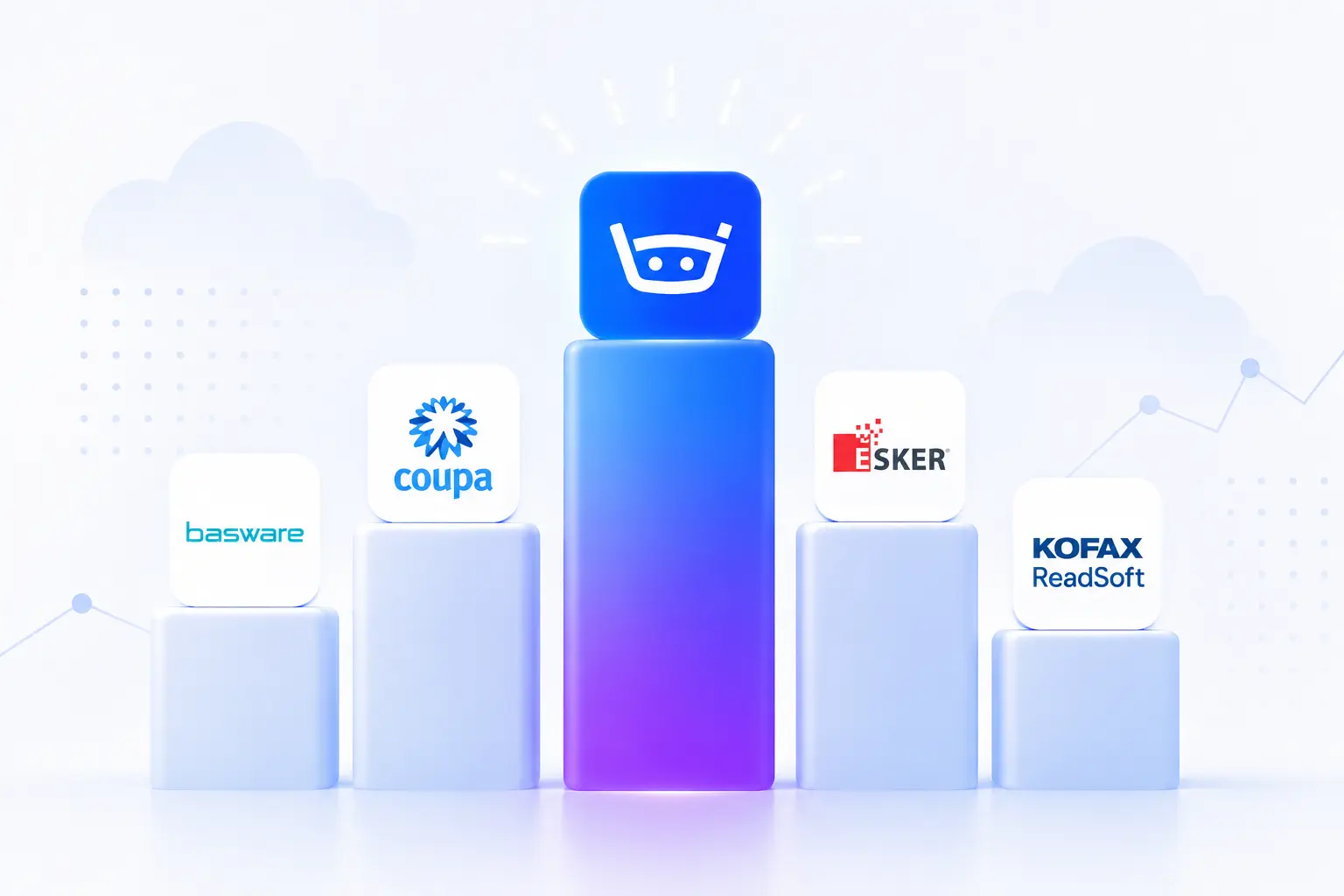
Oracle IDR (Intelligent Document Recognition) handles a useful slice of AP automation: clean PDFs from a small set of recurring suppliers, header capture, and basic coding. The broader problem for Oracle Fusion finance teams is not just capture, it is fragmentation. Requests, POs, invoices, approvals, vendors, payments, and cards sit across different systems, leaving finance to stitch context together after money is already moving. For Fusion teams that need more than recognition (line-level capture across distribution sets, multi-ledger posting, end-to-end approvals, PO matching, vendor management, and payment execution in one place), the right answer is usually a dedicated AP automation or procure-to-pay platform sitting above Fusion, not a heavier capture layer. This post compares the five Oracle IDR alternatives most often evaluated by Fusion AP teams in 2026.
Here is what this post covers:
- What Oracle IDR is and where it fits in the Fusion stack
- Why finance teams replace or extend Oracle IDR
- A side-by-side comparison of the top Oracle IDR alternatives
- Vendor-by-vendor breakdowns of Stampli, Basware, Coupa, Esker, and Kofax ReadSoft
- The evaluation criteria that matter for Oracle Fusion environments
- Why Stampli is the strongest replacement for Oracle Fusion AP teams
What Is Oracle IDR?
Oracle Intelligent Document Recognition (IDR) is a machine-learning capability built into Oracle Fusion Cloud ERP, specifically within Oracle Cloud Payables. According to Oracle, IDR extracts invoice information from emailed PDFs, creates invoices in Payables, and improves recognition over time as the AP team corrects mistakes. It is not a standalone product. If your organization runs Oracle Fusion Payables, IDR is already available to you, and Oracle updates it through quarterly cloud releases.
IDR supports a range of invoice header and line attributes and routes invoices into the Oracle scanned-invoices queue for AP review. AP teams then validate the data, correct any extraction errors, and route the invoice into the standard Fusion approval workflow.
Oracle IDR reaches limits as a recognition tool. It reads invoices and pushes data into Fusion. It is not an AP workspace, a vendor management hub, a PO matching engine, or a payments platform. For everything beyond capture, Oracle Fusion teams still depend on the standard Payables module, Oracle Procurement, or third-party tools.
Common strains of Oracle IDR
IDR works well for the right invoices. The friction shows up at the edges:
- Accuracy drops under variance. Recognition rates climb with consistent supplier formats and clean scans. Handwritten notes, rotated images, multi-page layouts, and non-standard line structures push more invoices into manual correction. Oracle IDR relies on three variables for its accuracy, scan quality, supplier consistency, and document complexity.
- Cost scales with volume. IDR processing and Fusion storage costs grow with invoice volume, which makes total cost harder to predict at month-end close than a flat subscription.
- Learning is supplier-specific. IDR learns from corrections, but improvement is tied to invoice similarity and layout patterns within a supplier. New vendors and new formats start from a lower baseline, and a correction on one invoice does not guarantee the next is read cleanly.
- Line-level coding gaps. Capturing full line detail with cost centers, multi-ledger distributions, and cross-validation rules is where IDR most often leaves manual work behind.
- No AP workspace. IDR feeds data into Payables. It does not give AP teams a collaborative invoice workspace, vendor onboarding, dynamic approval routing, PO matching, payments, or payment visibility in one place.
For mid-market and enterprise Oracle Fusion shops running high invoice volume across multiple ledgers, business units, and flexfield configurations, those gaps add up. So does the upkeep: ERP administrators and AP teams still monitor extraction exceptions, manage supplier profiles, and validate mappings and coding rules, and across hundreds or thousands of suppliers, even light per-supplier maintenance becomes a real operational load. That is what drives the search for an alternative.
Oracle IDR Alternatives Compared
| Capability | Oracle IDR | Stampli | Basware | Coupa | Esker | Kofax ReadSoft |
| Category | Capture inside Oracle Payables | End-to-end AP automation | Source-to-pay / AP automation | Spend management suite | Source-to-pay / AP automation | Capture + workflow (IDP) |
| AI approach | Supplier-trained ML | Template-free AI with contextual coding | InvoiceAI / SmartPDF | OCR plus AI extraction | Esker Synergy AI (ML + deep learning + GenAI) | Cognitive capture |
| Oracle Fusion integration | Native module | Direct REST API, no OIC | Connector via API, SFTP, or middleware | Pre-built integrations, often via OIC/SFTP/middleware | Standard Oracle connector | Posts via ERP connector, often via OIC for Fusion |
| End-to-end AP | No | Yes | Partial | Within Coupa suite | Partial | Capture + approvals only |
| Native PO matching | Basic in Fusion | 2-way / 3-way with line-level matching | Yes | Within Coupa suite | Yes | Line-item matching |
| Native Fusion data model parity | Native (within Fusion) | Yes, enforced automatically | No, handled downstream in Fusion | No, ERP-agnostic | No, standard connector | No, handled downstream in Fusion |
| G2 rating (2026) | N/A (part of Oracle Cloud) | 4.6 / 5 (1,856+ reviews) | 4.0 / 5 (121+ reviews) | 4.2 / 5 (555+ reviews) | 4.3 / 5 (28 reviews) | Part of Tungsten Automation portfolio |
1. Stampli
Quick facts
- Category: Complete Procure-to-Pay
- Oracle Fusion integration: Real-time, bidirectional REST API. No Oracle Integration Cloud or IDR add-on dependency for the AP workflow
- P2P scope: Invoice capture, AI coding, 2-way and 3-way matching, approvals, vendor management, payments, card
- AI approach: Stampli AI is trained on billions of real-world transactions across $150 billion in annual spend and continuously improves with every correction, while human review and approval remain in control
- G2 rating (2026): 4.6 / 5 across 1,856+ reviews
Stampli is the only AP automation and procure-to-pay platform with a direct, bidirectional Oracle Fusion API integration. Invoices, payments, vendors, and PO status sync in real time. Two-way deep links connect every Stampli record back to the exact Fusion record. No Oracle Integration Cloud or IDR add-on dependency for the AP workflow.
That integration model is paired with full Oracle Fusion data parity. Distribution sets, vendor defaults, included/excluded tax logic, header and line flexfields, multi-ledger support, and two-way cross-validation rules are all enforced automatically across business units. AP teams do not memorize valid coding combinations. Stampli does. Instead of cleaning up errors after they reach Fusion, Stampli validates invoices against Fusion rules before posting.
On capture, Stampli replaces IDR. Built-in OCR, intelligent header and line capture, vendor discount detection, and AI-driven coding are included with no per-document fees and no template retraining when a vendor changes its format. Stampli AI suggests coding, routing, matching, and exception handling inside ERP-aligned workflows, and humans confirm, correct, and approve before posting. Across Stampli’s customer base, the platform automates 87% of finance work across 2,500+ ERP-aligned fields.
Beyond capture, Stampli covers the rest of procure-to-pay in one workspace: live PO and receipt data for 2-way and 3-way matching, partial receipts, line-level matching, vendor management and onboarding, pre-export validation that catches duplicates and invalid coding combinations before they reach Fusion, payments execution, Stampli Card for spend management, and an approver workspace that does not require a Fusion seat for every department manager.
Stampli was named to the 2026 Best ERP Software Products list in G2’s Best Software Awards, a recognition based on verified customer reviews and market presence data across G2’s marketplace.
2. Basware
Quick facts
- Category: Source-to-pay and AP automation platform
- Oracle Fusion integration: Connector-based via API, secure XML file transfers, or middleware
- AP scope: Invoice capture (SmartPDF), matching, workflow, e-invoicing
- AI approach: Basware InvoiceAI for extraction, validation, and exception handling
- G2 rating (2026): 4.0 / 5 across 121+ reviews
Basware is an AP automation and e-invoicing platform built around its InvoiceAI offering. According to Basware’s ERP integrations page, the platform connects to 250+ ERPs (including Oracle) through certified connectors, APIs, secure XML file transfers, and middleware. SmartPDF is Basware’s PDF data capture service. The company emphasizes country-by-country e-invoicing compliance for organizations subject to mandates in Europe, Latin America, and Asia.
For Oracle Fusion specifically, integration is connector-driven rather than a Fusion-specific direct API. Customers typically connect through API, SFTP, or middleware, with implementation effort that scales with the environment. One Basware G2 reviewer puts the Oracle experience plainly: “It does not work well with Oracle Finance.”
Gartner Peer Insights reviewers note that Basware approvers can approve any invoice type up to their dollar threshold rather than being limited to specific GL accounts or expense categories. The same reviewers describe duplicate invoice detection as adequate rather than strong, and call out initial setup and mapping as areas where more guided configuration would help.
The trade-off for Oracle Fusion AP teams: Basware can post into Fusion, but it does not mirror Fusion-specific structures (distribution sets, cross-validation rules, header and line flexfields) natively. Those still get handled downstream inside Oracle Payables.
3. Coupa
Quick facts
- Category: Total spend management suite with AP as one module
- Oracle Fusion integration: Typically Oracle Integration Cloud, SFTP, or middleware
- AP scope: Invoice capture, matching, approvals within the broader Coupa platform
- AI approach: OCR-based extraction with AI for coding and exception detection
- G2 rating (2026): 4.2 / 5 across 555+ reviews
Coupa is a spend management suite with invoice automation positioned as one module alongside procurement, expense, sourcing, and treasury. Coupa’s AP capabilities include AI-driven OCR-based extraction, automated matching, and approval workflows.
Oracle Fusion integration is handled through Oracle Integration Cloud, SFTP, or middleware. Integration partners documenting the pattern describe scheduled OIC jobs that read approved invoices from Coupa, transform the data, validate it, and post it into Oracle Fusion Payables, with bidirectional acknowledgment back to Coupa. Bidirectional sync is supported but requires meaningful configuration and ongoing OIC ownership. One Coupa G2 reviewer describes the practical impact this way: “The integration with Oracle is still a little lacking,” noting that Oracle sync delays can become a problem when a PO needs to be cut and received immediately.
Implementation also runs long. G2 reviewers and third-party comparison content describe 6 to 18 month deployments, specialized consultants, and process re-engineering. Coupa’s structure assumes organizations will adapt their workflows to the platform.
The trade-off for Oracle Fusion AP teams: Coupa is ERP-agnostic by design, so Fusion-specific structures (distribution sets, cross-validation rules, multi-ledger posting, header and line flexfields) sit downstream of Coupa rather than mirrored inside it.
4. Esker
Quick facts
- Category: Source-to-pay and order-to-cash platform
- Oracle Fusion integration: Standard Oracle connector (E-Business Suite, JD Edwards, Fusion via standard interfaces)
- AP scope: Invoice capture, coding, approval workflow, posting to ERP
- AI approach: Esker Synergy AI (machine learning, deep learning, and integrated generative AI through Esker Synergy GenAI)
- G2 rating (2026): 4.3 / 5 across 28 reviews
Esker is a source-to-pay and order-to-cash platform with AP automation as one of multiple modules. According to Esker’s AP automation page, the platform’s AI engine combines machine learning, deep learning, and generative AI, with Esker Synergy GenAI integrated into the solution rather than requiring a separate LLM provider. Esker provides standard connectors for SAP, Oracle, and Microsoft and supports simultaneous integration with 70+ ERPs.
For Oracle environments, Esker publishes connectors for Oracle E-Business Suite and JD Edwards EnterpriseOne. Oracle Fusion integration uses standard interfaces rather than a Fusion-specific direct REST API. One Esker G2 reviewer summarizes the data-alignment friction directly: “Integration and alignment of data between Esker and generic ERPs can be a challenge.”
Esker’s G2 Ease of Setup score sits at 7.1 out of 10, with reviewers describing longer onboarding cycles and the complexity that comes with a multi-module platform. The 28-review sample size on G2 is also smaller than peer products, which limits statistical confidence in user-sentiment patterns.
The trade-off for Oracle Fusion AP teams: Esker covers AP, AR, and procurement, but the breadth comes at the cost of Fusion-specific depth. Distribution sets, cross-validation rules, and multi-ledger posting are not handled with the parity a Fusion-native AP tool provides.
5. Kofax ReadSoft (now Tungsten AP Essentials)
Quick facts
- Category: Cloud-based invoice capture and validation (IDP)
- Oracle Fusion integration: ERP connector for posting; Fusion-specific configuration handled downstream
- AP scope: Capture, extraction, validation, two- and three-way matching, approval routing, posting
- AI approach: Cognitive capture, part of the broader Tungsten Automation Platform
- G2 rating (2026): No standalone G2 product page with current review volume
Kofax ReadSoft Online, now rebranded as Tungsten AP Essentials following Kofax’s transition to Tungsten Automation, is a cloud invoice capture and validation product. It is part of the broader Tungsten Automation Platform, which also includes TotalAgility for more complex document and workflow scenarios.
AP Essentials handles capture, extraction, validation, two- and three-way matching, approval workflow routing, and posting into ERPs (including Oracle, SAP, Microsoft Dynamics, and NetSuite). It is a SaaS multi-tenant invoice processing product, not an end-to-end AP workspace or a payments platform.
For Oracle Fusion specifically, AP Essentials posts validated invoices into Fusion through its ERP connector. Fusion-specific structures and approvals continue to live in Oracle Fusion downstream. The product is sometimes still referenced by its legacy name (Kofax ReadSoft Online), so buyers should map old and new naming during procurement to avoid duplicate vendor listings.
The trade-off for Oracle Fusion AP teams: AP Essentials replaces some of what IDR does (with stronger capture and a separate workflow layer), but it stops short of full AP automation. Vendor management, payments, and the AP workspace itself remain elsewhere in the stack.
What to Look for in Oracle IDR Alternatives
Before lining up vendors, set the criteria that actually matter for Oracle Fusion environments. The five-vendor list above looks different depending on which of these weigh most.
1. AI-Assisted Capture with ERP-Validated Accuracy
Template-free, ML-driven extraction that handles header and line data across varied supplier formats, not just clean PDFs. The 2026 baseline is AI that improves continuously from corrections and is validated against ERP rules before posting. Pre-trained models, contextual extraction, and human review and approval should all be part of the answer, with accuracy that improves as the system learns from corrections.
2. Direct Oracle Fusion Integration Without Middleware
A direct REST API connection avoids the cost and maintenance overhead that Oracle Integration Cloud and flat-file middleware typically introduce. Ask each vendor whether the integration is a Fusion-specific direct API or a generic connector orchestrated through OIC, SFTP, or another middleware layer. The answer changes implementation timelines and ongoing maintenance materially.
3. Support for Oracle Fusion Ledgers, BUs, Legal Entities, and Flexfields
Multi-ledger posting, business units, legal entities, and header/line flexfields are where Fusion environments get complicated. The right alternative mirrors those structures inside the AP layer instead of flattening them for a generic AP workflow. Cross-validation rules and dynamic filtering for valid coding combinations should be supported natively.
4. Native Distribution Sets, Vendor Defaults, and Tax Logic
Distribution sets are a major Fusion AP requirement. Capture-only tools extract the invoice amount but do not apply the allocation. Look for a platform that imports Fusion distribution sets, applies them during coding (with AI suggestions), and supports vendor defaults, included/excluded tax scenarios, and the rest of the Fusion configuration you already rely on.
5. Live PO and Receipt Sync for 2-Way and 3-Way Matching
PO matching is where capture-only tools show their limits. Fusion AP teams need partial receipts, multiple POs per invoice, one PO across multiple invoices, freight, tax, miscellaneous charges, tolerances, and change orders. Live PO and receipt data inside the AP workspace beats bouncing between systems.
6. Built-In Validation Before Data Reaches Oracle Fusion
Errors caught inside the AP layer never become Fusion problems. Pre-export validation should cover duplicates, invalid coding combinations, mismatches, missing information, and policy issues. Fusion should not be the first place an error surfaces.
7. Lower Total Cost Without Extra IDR, Middleware, or Oracle Seat Costs
Total cost of ownership includes more than the AP automation subscription. Factor in Oracle IDR processing, Fusion storage costs, additional Fusion seats for approvers, and the implementation and maintenance labor that middleware introduces. The cheapest license is sometimes the most expensive total bill across a full procure-to-pay process.
Why Stampli Stands Out Among Oracle IDR Alternatives
Most invoice capture tools can map an invoice number, date, supplier, amount, and a line description. That is not enough for Oracle Fusion. The job is to keep requests, POs, invoices, approvals, vendors, payments, and cards connected so finance is not stitching context together after money is moving.
Stampli is built around six things that matter specifically for Fusion AP teams:
- Direct Fusion API. Real-time, bidirectional sync with Oracle Fusion via REST API. Invoices, payments, vendors, and PO status update through the same connection. Two-way deep links connect every record back to Fusion. No Oracle Integration Cloud or IDR add-on dependency for the AP workflow.
- Full Fusion data parity. Native support for header and line flexfields, distribution sets, multi-entity configurations, and cross-validation rules. Rules are enforced automatically across every business unit, not memorized by AP. Instead of cleaning up errors after they reach Fusion, Stampli validates invoices against Fusion rules before posting.
- AI that replaces IDR. Built-in OCR, smarter header and line capture, intelligent coding, and vendor discount detection. The IDR license and template-retraining cycle drop out of the AP workflow. Stampli AI suggests coding, routing, matching, and exception handling inside ERP-aligned workflows, and humans confirm, correct, and approve before posting.
- Live PO intelligence. 2-way and 3-way matching, one-to-many and many-to-one POs, partial receipts, line-level detail, and frequent PO and receipt refresh inside the AP workspace.
- Pre-export validation. Duplicates, invalid coding combinations, mismatches, and policy issues are caught inside Stampli before they reach Fusion. Suspense accounts, failed exports, and month-end rework drop.
- Procure-to-pay breadth. Beyond AP, Stampli covers procurement, vendor management, payments, and Stampli Card in one workspace. Approvers and viewers across the business collaborate inside Stampli without each needing a Fusion seat.
The Best Oracle IDR Alternative for Oracle Fusion AP Teams
Oracle IDR is an add-on for invoice capture. That is what it was built for, and inside its scope, it works.
Stampli is a complete, ERP-integrated procure-to-pay platform built for Oracle Fusion. Real-time integration. Full data model alignment. AI-assisted capture and coding with ERP-validated accuracy. No Oracle Integration Cloud or IDR add-on dependency for the AP workflow. Everything Oracle IDR does, plus the rest of the procure-to-pay cycle (procurement, vendor management, payments, and card) that Oracle Fusion teams currently solve with manual work, OIC recipes, or layered point tools.
Basware, Coupa, Esker, and Kofax ReadSoft each cover a slice of the same problem, but each one stops short on one of the criteria that matter most for Fusion environments: direct API integration, Fusion-specific data model parity, end-to-end procure-to-pay scope, or fast time to value. For Oracle Fusion AP teams replacing Oracle IDR, Stampli is the most direct path from request to reconciliation without rebuilding the Oracle stack.
If you are evaluating Oracle IDR alternatives, the three questions that sort the field quickly are:
- Is your Oracle Fusion integration a direct REST API or middleware-orchestrated?
- Do you enforce distribution sets, flexfields, cross-validation rules, and multi-ledger posting natively?
- Is the end product a connected procure-to-pay workspace covering requests, POs, invoices, approvals, vendors, payments, and cards, or a capture queue feeding back into Fusion?
See how Stampli works with Oracle Fusion. Book a demo with an Oracle Fusion specialist.