
Why Your P2P Workflow Is Breaking (and What to Do About It)
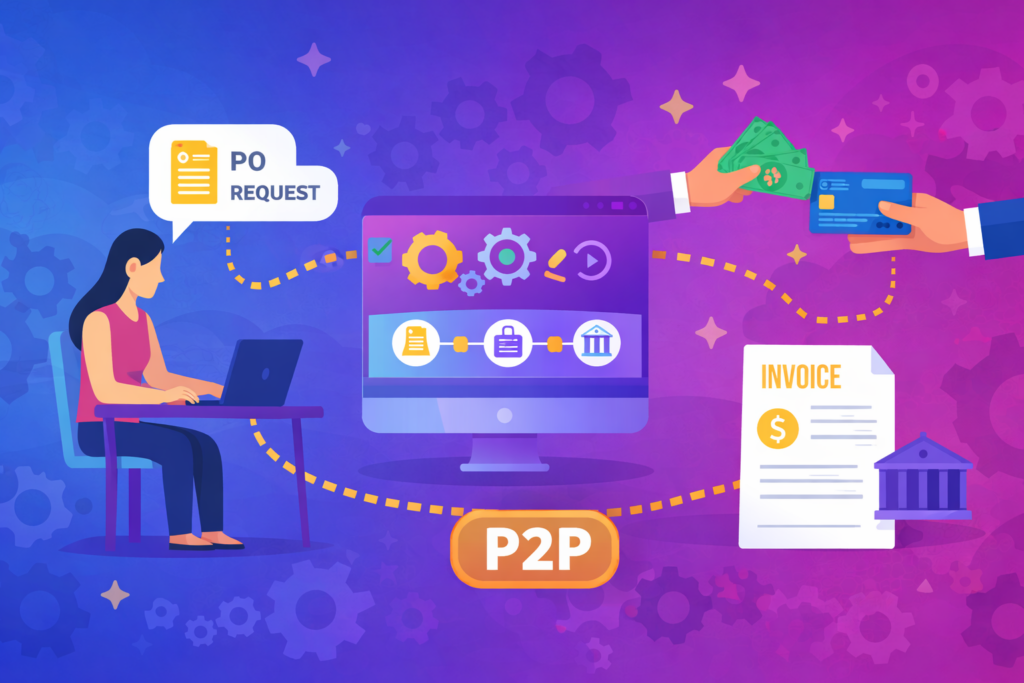
Your procure-to-pay workflow isn’t failing because your finance team is inefficient. It’s failing because mid-market complexity has outgrown how that workflow was assembled.
The real breakdown happens when organizations try to manage procurement, accounts payable, and payments as separate functions loosely connected by email, spreadsheets, and institutional knowledge. As you scale, that fragmentation becomes unsustainable.
What Mid-Market Complexity Actually Looks Like
Mid-market is often defined by revenue or headcount. But operationally, you’ve crossed into true mid-market complexity when you’re processing 300+ invoices monthly, managing $15M+ in non-payroll spend, juggling multiple entities or locations, and navigating an ERP shaped by years of customization and audit requirements.
At this point, informal processes can’t absorb the pressure. And here’s the critical insight: this complexity isn’t linear. Each new vendor, entity, or approval rule multiplies effort across the entire P2P lifecycle. A change in procurement echoes through AP and surfaces again in payments and reconciliation.
Where the Friction Actually Lives
In procurement: Mid-market organizations rarely centralize purchasing. Requests come through email, Slack, verbal conversations, and vendor-sent invoices. The challenge isn’t stopping decentralized demand, it’s bringing structure to it before commitments are made. When budget visibility doesn’t exist at the point of request, finance discovers overages after spend is already committed.
In accounts payable: AP becomes where procurement intent meets financial reality. Invoices reflect how work actually happens, partial receipts, multi-PO allocations, price discrepancies. This isn’t inefficiency; it’s governance. But as volume increases, workload doesn’t scale linearly. Each additional invoice introduces more exceptions and follow-up.
In payments: Once a payment executes, errors become expensive and visible. Multiple payment methods (ACH, checks, cards, wires) each have different timing, reconciliation behavior, and failure modes. Vendor data becomes a risk surface. And timing decisions around cash, discounts, and FX exposure must remain traceable.
The Real Problem: Handoffs, Not Tools
Most mid-market teams assemble P2P from multiple tools, an intake platform here, an AP solution there, payments handled elsewhere. Each tool may work fine on its own. The problem is the handoffs: requests approved without budget context, PO details lost before invoice review, approvals disconnected from payment execution, vendor changes untied to payment authorization.
The consequences are tangible: manual reconciliation at month-end, audit exposure, late payments, missed discounts, staff burnout, and an inability to scale without adding headcount.
What Unified P2P Actually Means
A unified system isn’t about features—it’s about ensuring connections between procurement, AP, and payments don’t break under pressure. Context captured at the point of request flows into AP. The system accommodates real-world variability without breaking controls. Approval logic routes dynamically based on thresholds, entities, and accounts. And everything syncs with your ERP in real time.
Consider the results: Purple, processing 1,100+ invoices monthly across 1,350 vendors, reduced invoice processing time from 8 days to 3 without adding staff. LTC Ally, onboarding up to 30 new facilities monthly, now brings new entities online in a single day. Their employee-to-facility ratio dropped significantly because complexity became structured rather than manual.
The Bottom Line
When procurement, AP, and payments operate as one system with shared context and consistent controls, complexity transforms from a manual burden into a manageable asset. Finance teams grow output, not headcount. That’s not a technology pitch, it’s operational reality for mid-market companies that have made the shift.
Want to go deeper? Read The Complexity Challenge in Mid-Market Procure-to-Pay.
