Finance teams don’t lose control all at once. It happens in small moments: a card swipe without a purchase request, an approval that comes after the money is already spent, a transaction that posts to the ERP with the wrong coding. Each one feels minor. Together, they become the reclassifications, audit gaps, and month-end fire drills that consume your closing week.
The problem isn’t a lack of policy. Most organizations already have procurement policies, card usage policies, and expense policies. The problem is that the systems employees use make it easier to bypass the policy than to follow it.
What follows is a practical framework for building a spend control process across the full procure-to-pay workflow, covering procurement intake, corporate card controls, and ERP validation, that prevents rework before it starts.
Why Mid-Market Finance Teams Outgrow Their Spend Controls
If you run finance at a mid-market company, you know the tension. You have the transaction volume of an enterprise, the multi-entity complexity of a holding company, and the exception density of a company still building its controls. But you don’t have the headcount or systems budget that enterprises rely on.
The tools designed to help often make it worse. Enterprise platforms assume dedicated administrators. SMB tools assume simple approval chains. Mid-market finance teams end up in the gap: too complex for lightweight tools, too lean for enterprise overhead.
The result is a spend control process that works on paper but breaks in practice. Requests get submitted after purchases are made. Card transactions post without context. AP inherits errors that should have been caught upstream.
Three Places Where Corporate Card Controls and Spend Governance Break
Most spend control failures don’t originate in AP. They originate upstream, in the moments where commitments are made without the right context.
- Procurement Intake: Requests That Become Commitments Without Alignment
A procurement approval workflow is the structured process by which purchase requests are submitted, reviewed, and authorized before money is committed. It’s where organizational intent is supposed to be captured. In practice, many mid-market teams don’t have a functioning requisition workflow. Requests happen over Slack, over email, or not at all. By the time a formal request shows up, it’s a ratification, not a decision.
The consequences compound:
- Duplicate purchases across departments because nobody checked existing contracts
- Budget overruns that surface only at close, not at the point of commitment
- Vendor onboarding that happens retroactively, creating compliance gaps
- Missing audit trail for how and why a purchase was authorized
A working procurement approval workflow captures intent before commitment. Approvals route automatically. Budget context is visible before anyone submits. Employees move faster than the ad hoc alternative because the structured path eliminates back-and-forth.
- Corporate Card Controls: When Swipes Happen Before Alignment
Corporate card controls are the policies, limits, and system-level guardrails that govern how employees use company-issued cards. For mid-market teams, this is where governance struggles the most. Cards give employees purchasing autonomy. But autonomy without structure becomes unmanaged spend.
The pattern: an employee gets a card with a category limit and a monthly cap. Each individual transaction is within policy. But nobody checks whether the purchase was budgeted, whether the vendor is approved, or whether the GL coding will be correct when the charge hits AP.
The card becomes a decision-making tool rather than a payment mechanism. AP inherits a stream of transactions with no upstream context: no linked purchase request, no pre-approved vendor, no validated coding. Every transaction requires manual investigation and reconciliation.
Effective corporate card controls do more than set limits. They connect every charge to the intent that justified the spend. This is spend management, not spend encouragement.
- AP Posting: Errors and Rework After the Fact
ERP validation is the process of confirming that a transaction conforms to your organization’s accounting rules before it posts to the general ledger. Even when procurement intake and card controls exist, the final failure point is this posting layer. Transactions that pass through approval workflows still need validation against accounting rules before they post. Without this step, errors propagate into the ledger.
Common failures at this stage include:
- GL codes that conflict with entity-level rules or the chart of accounts
- Missing or incorrect PO matching that creates exceptions during close
- Approvals granted by the wrong person, creating audit findings
- Transactions posted to a closed period or the wrong subsidiary
When ERP validation happens after posting, it’s called reclassification. When it happens before posting, it’s called control. The difference is a clean close versus a painful one.
Control Before Commitment: A System, Not a Policy
In a previous piece from Stampli’s CEO and Co-Founder Eyal Feldman, on the Enterprise Dopamine Reward Loop, he introduced the moment of reflection. A structured pause before an irreversible financial decision.
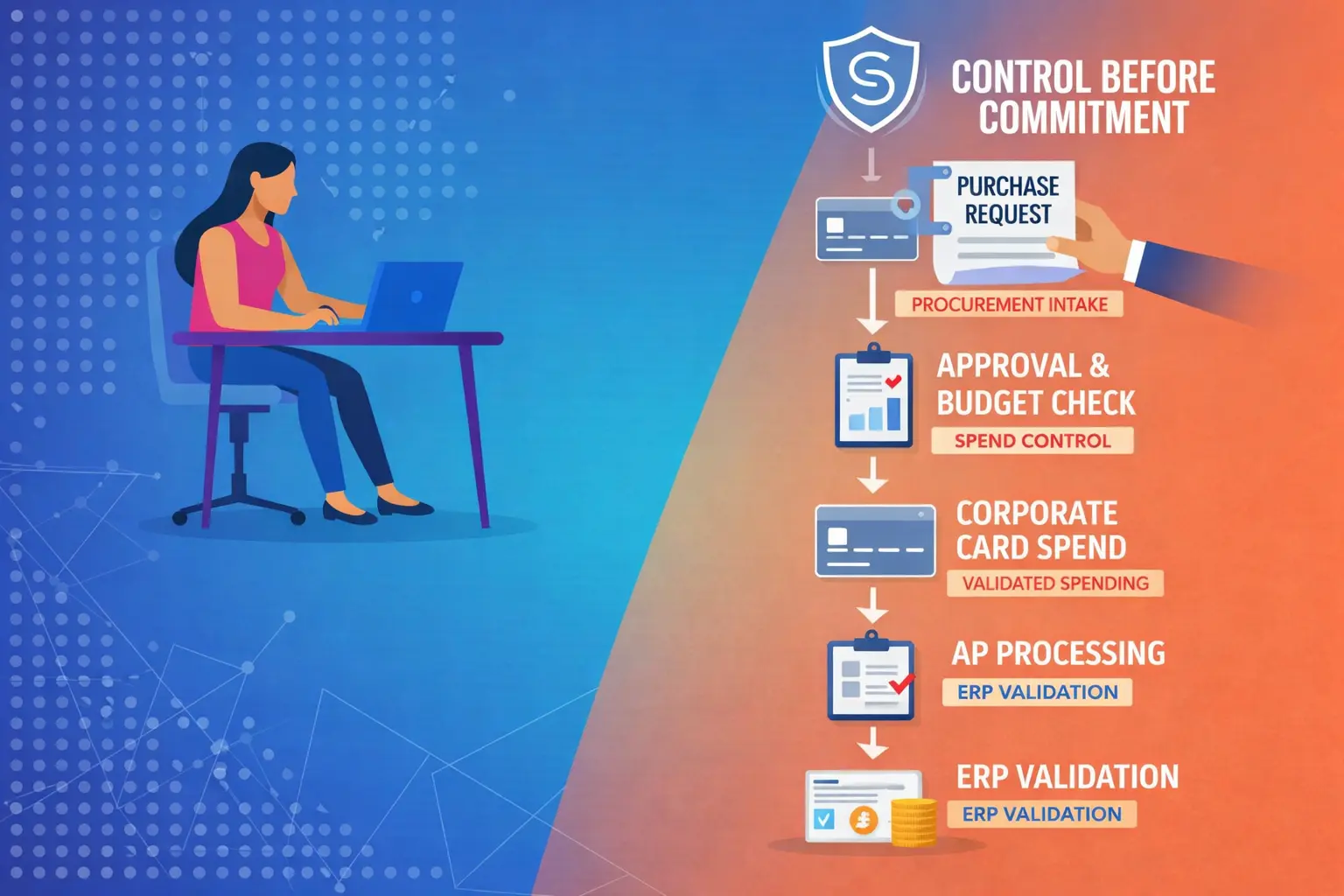
The principle: control before commitment. Every irreversible financial commitment, whether from a purchase request, a card swipe, or an invoice payment, passes through a structured checkpoint before it becomes irreversible. Not after.
Control before commitment means building the policy into the system architecture so following it is the path of least resistance.
Spend Control Checklist for Every Transaction
A spend control process works when every transaction, regardless of whether it originates from a purchase request, a corporate card, or an invoice, clears four checkpoints before it becomes a financial commitment.
- Budget Context
Before any commitment is made, the requester and approver should both see the budget impact: how much has been committed, what’s remaining, and whether this purchase changes the forecast. This transforms the purchase request from a form to fill out into a decision with visible consequences.
- Correct Coding
GL codes, cost centers, departments, and entity assignments should be validated at the point of request, not at the point of posting. When coding is done upstream, AP doesn’t have to guess. When it’s done downstream, AP spend becomes more time correcting than processing.
- Right Approver
Approval routing should be dynamic, based on amount, category, entity, vendor, and department. Static chains that route everything to the same manager create two problems: low-risk transactions wait unnecessarily, and high-risk transactions don’t get scrutiny. A well-designed requisition workflow routes each request to the person with actual authority to evaluate it.
- ERP Validation Before Posting
The final gate. Before any transaction posts to your ERP, it should be validated against your accounting rules: GL code existence, open period, PO match, vendor record completeness, entity alignment. When this validation happens before posting, you eliminate reclassifications, correction journal entries, and accrual adjustments. All symptoms of validation that happened too late.
Building End-to-End Spend Control with Stampli
Stampli is a procure-to-pay platform that runs processes from request through payment. Each layer below is part of a unified workflow, not a set of disconnected point tools. The platform mirrors your ERP’s chart of accounts, entities, dimensions, and approval hierarchies, so every transaction is validated against your rules before posting.
Procurement Controls Before Commitment
Stampli Procurement captures every purchase request before it becomes a PO, a card charge, or a service ticket. Each request begins with budget validation, GL coding, and approval ownership already in place. Workflows can be configured for any request-to-fulfillment path, whether the request becomes a purchase order, a card, or a service engagement.
Stampli’s AI supports the process by surfacing preferred vendors, suggesting GL codes, and filling in fields automatically so employees focus on informed decisions rather than data entry. By the time a commitment is made, the need is validated, the budget is confirmed, and the approval is documented.
Corporate Card Spend Management
Most card programs are designed to increase volume. Stampli Card is designed to increase intent. It offers two types of card spend, both built into existing P2P workflows:
- AP Cards are issued directly from approved purchase requests with pre-coded GLs and project codes, a linked approval chain, and budget context already attached. They’re treated like invoices in your approval workflow, eliminating parallel systems and reconciliation gaps.
- Expense Cards empower employees to request cards and reload funds while finance maintains proactive control through spending limits by cardholder, merchant category, or vendor. Real-time transaction posting and mobile receipt prompts reduce receipt chasing and month-end cleanup.
This addresses the root cause of rogue spend: cards that function as open-ended purchasing authority with no upstream alignment.
ERP Validation and Posting Controls
Before any transaction posts, Stampli validates it against your ERP’s rules: GL code validation, 2-way and 3-way PO matching at the line level, approval hierarchy compliance, period and entity assignment, and vendor record completeness. Every action is captured in an immutable audit trail. No reclassifications at close. No accrual surprises. No audit gaps.
AI That Does the Work, Trained on Over 2,500 ERP Fields
Stampli’s AI is embedded directly into every workflow, not layered on after the fact. Trained on $150 billion in annual spend, it generates field-level suggestions across requests, invoices, and receipts. On average, it performs 86% of finance work across 2,500+ unique ERP-aligned fields. All suggestions remain subject to human review and approval before posting.
Across the full procure-to-pay lifecycle, the AI operates continuously:
- Applies business rules and accounting logic to code transactions automatically
- Predicts approvers based on organizational structure and past behavior
- Performs line-level PO matching, even with inconsistencies
- Flags duplicates, variances, and compliance risks proactively
- Learns from corrections to continuously improve accuracy
AI handles the permutations. Your team keeps the judgment. This is anti-impulse, not anti-speed.
Impact on Finance Teams and Operations
For AP Directors, transactions arrive coded, approved, and validated. The close gets shorter because the cleanup disappears. For Controllers, the audit trail is continuous from request through payment. For CFOs, spend becomes strategic: you review requests before commitment, not dashboards after the fact. A working spend control process across procurement, corporate cards, and AP posting is what separates reactive finance teams from ones that scale.
Decision quality is the competitive advantage nobody is measuring.