It’s the second week of close. Your team is still untangling cost allocations, chasing stakeholders over email, rebuilding split logic in spreadsheets, and posting journal entries to fix invoices that were coded weeks ago.
This is the default for most AP and finance teams. And it points to a structural problem: cost allocation happens at exactly the wrong time. After the invoice is posted. After context has faded. After the people who understand the costs have moved on.
The result? Cost accounting data that doesn’t reflect reality, and activity-based costing models built on a foundation of month-end guesswork.
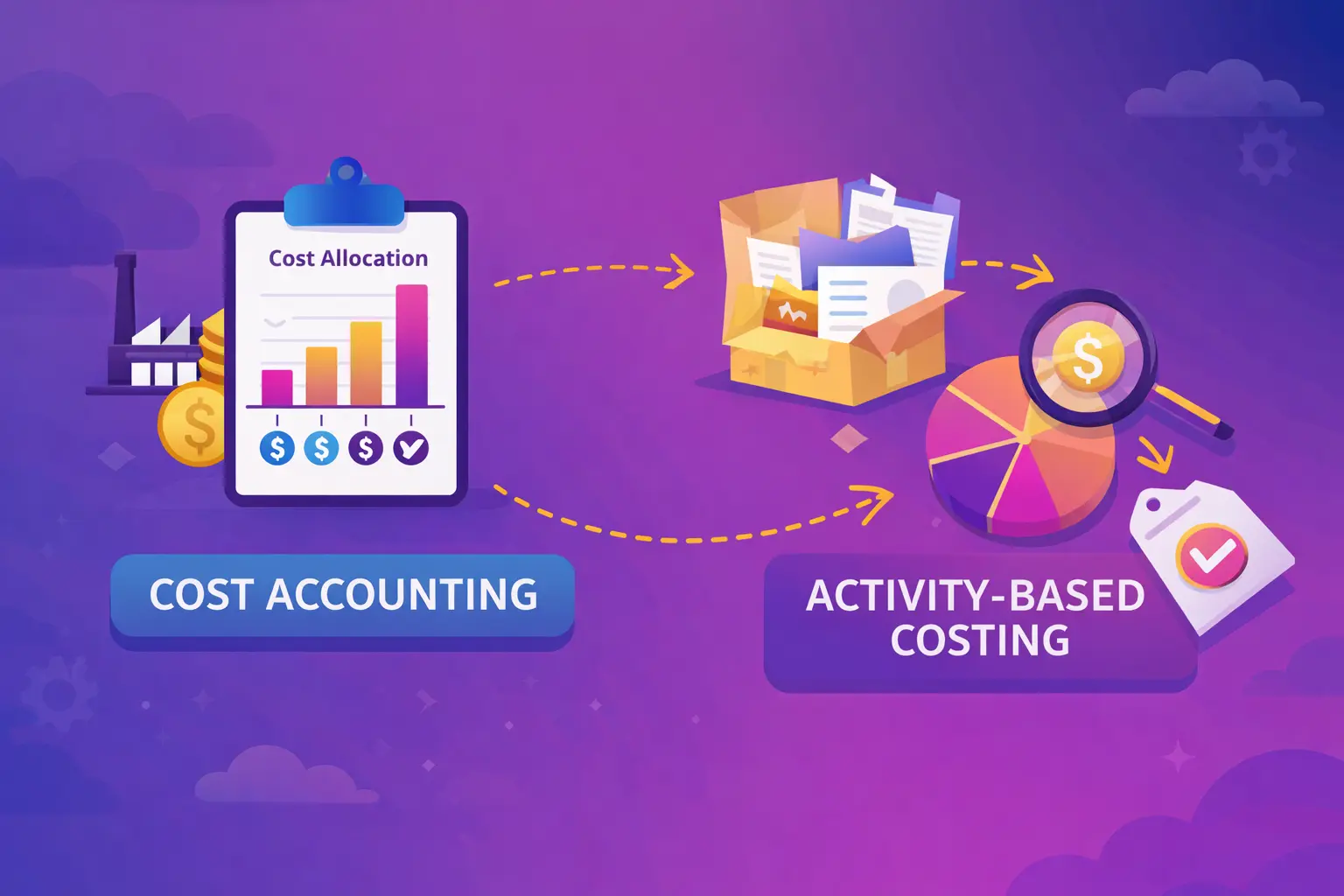
Cost Accounting Versus Activity Based Costing
Cost accounting ensures that every cost tied to producing and delivering a product (direct materials, labor, and allocated overhead) is accurately reflected in that product’s total cost. Done well, it gives you reliable COGS, true product margins, and the visibility to make sound pricing and investment decisions.
Activity-based costing (ABC) takes cost accounting further. Rather than spreading indirect costs using broad averages like a single plant-wide overhead rate, ABC traces costs to the specific activities that drive them: receiving, inspection, vendor management, freight handling. Costs are then assigned based on how much of each activity a product actually consumes.
The concept is sound. The problem is the data feeding it.
Your Allocation Workflow is Working Against You
Most companies don’t capture accurate cost allocations when they process invoices. Instead, the typical workflow looks like this:
- The invoice arrives. AP codes it to a GL account and posts it.
- Days or weeks later, someone realizes the cost needs to be split across departments, projects, or line items to reflect true landed cost.
- AP builds a spreadsheet, creates correcting journal entries, and chases stakeholders for context they should have had upfront.
The consequences compound quickly:
- Distorted margins. A shared freight charge coded entirely to one product line inflates that line’s COGS and understates another’s. Profitability reporting becomes unreliable.
- Longer close cycles. Every late allocation becomes a reconciliation task. Rework piles up. The close stretches.
- No audit trail. When allocation decisions live in emails and side conversations, there’s no structured record of who decided what or why. That’s a governance and compliance risk.
- Weakened ABC models. Activity-based costing is only as good as the cost data feeding it. When that data is approximate or reconstructed from memory at month-end, your activity drivers and cost pools are wrong, and so are the insights.
It’s Not a People Problem. It’s a Timing Problem.
ERPs bury critical cost details (PO distributions, landed cost components, charge items) across multiple screens and modules that AP can’t easily access. The people who actually know how costs should be allocated (operations managers, procurement leads, project owners) aren’t part of the AP workflow. And approvers often review invoices without seeing the full cost structure, leading to coding guidance that AP has to unwind later.
Cost allocation is treated as an afterthought because the systems are designed that way. That’s the root cause, and no amount of spreadsheet discipline can fix a timing problem.
What Changes When You Allocate Costs at the Point of Invoice
Stampli solves this by embedding cost allocation directly into the invoice-coding workflow, before the data ever reaches the ERP.
When a team processes an invoice in Stampli, Stampli AI automatically handles the heavy lifting, coding fields, applying business rules, enforcing allocation logic, and validating entries against ERP dimensions in real time. Because Stampli AI is trained on millions of hours of real finance work, it learns your organization’s patterns and applies them consistently, so allocation decisions are captured accurately before posting rather than reconstructed after the fact.
Allocation decisions are captured in real time using the organization’s native accounting dimensions. Rules are enforced before posting, so the ERP stays as the system of record, but the data entering it is validated, complete, and accurate from the start.
Stampli doesn’t replace the ERP. It improves the quality of the cost accounting data flowing into it. Context is fresh. Stakeholders are involved. And ERP data stays clean.
How Stampli Makes Cost Accounting and Activity-Based Costing Actually Work
True charge allocation, not just GL distribution.
Many AP tools can classify a cost to a general ledger account. But accurate cost accounting often requires charge allocation: spreading indirect costs like freight, duties, and surcharges across specific line items to reflect true landed cost. This directly impacts inventory valuation, COGS, and margin reporting. Stampli supports real charge allocation within the workflow, so product profitability reflects total cost, not just purchase price.
Built-in stakeholder collaboration.
The people who understand how costs should be split (department heads, operations, procurement) are rarely in AP. Stampli brings them directly into the invoice workflow with integrated real-time messaging and free internal user access. Allocation decisions are clarified collaboratively and captured automatically. No chasing. No disconnected email threads.
A complete, auditable cost trail.
Stampli logs every coding change, message, approval, and decision tied to an invoice in a chronological record. Every allocation carries documented accountability: who decided, why it was split that way, and when it was approved. This transforms allocation from an undocumented adjustment into a transparent, auditable business decision.
Cleaner inputs for ABC models.
Most systems that claim to support activity based costing start after the damage is done. Stampli captures allocation decisions within the invoice workflow and validates them against ERP rules before posting. That means the cost pools and activity drivers feeding your ABC model are based on real, documented decisions, not month-end best guesses.
Less rework per employee, not just faster closes.
Moving allocation upstream doesn’t just improve data quality, it dramatically reduces the manual reconciliation burden per employee. For lean mid-market and enterprise finance teams managing high invoice volumes without proportional headcount growth, that distinction matters. Stampli AI absorbs the allocation workload that would otherwise require additional hires, so teams can scale throughput without scaling headcount.
Stop Fixing Allocations. Start Capturing Them.
Late allocations distort margins, extend close cycles, create compliance risk, and undermine every cost accounting model built on top of them. The fix isn’t more spreadsheets or ERP customization. It’s capturing the right cost decisions at the right time.
Stampli moves allocation upstream, into the invoice workflow, so organizations get cleaner ERP data, faster closes, reliable margin visibility, and activity-based costing that reflects how the business actually operates.
And because AP is just one piece of a broader procure-to-pay process, those gains compound when allocation accuracy extends across procurement, vendor management, and payments, reinforcing financial control at every step of the P2P workflow, not just at the invoice stage.