The complexity challenge in mid-market procure-to-pay
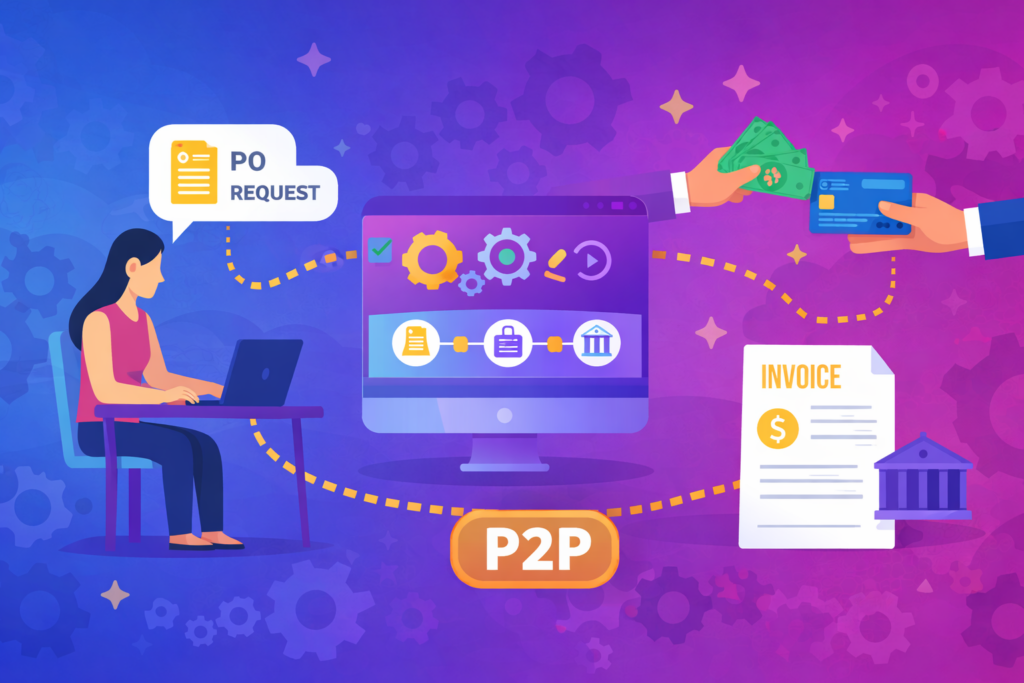
Procure-to-pay workflows aren’t failing because finance teams are inefficient.
They fail because mid-market complexity outgrows the way those workflows were assembled and are operated.
What breaks down for mid-market finance teams is the attempt to manage procurement, accounts payable, and payments as loosely connected functions rather than as a single operating system.
A unified procure-to-pay model is how mid-market companies manage complexity without adding headcount or losing control. Purchasing, invoices, approvals, and payments flow through one system with shared context and consistent controls instead of scattered across tools that don’t talk to each other.
The problem is that most mid-market organizations never fully reach that state. They operate partial P2P: a request tool here, an AP tool there, payments handled elsewhere, all tied together with manual work, email, and institutional knowledge.
As organizations grow, that fragmentation becomes unsustainable.
This article explains:
- Why mid-market P2P is inherently complex
- Where that complexity originates across procurement, AP, and payments
- Why a unified P2P system, not a collection of point solutions, is the only way to scale without losing control, visibility, or people
What is mid-market complexity in procure-to-pay?
Mid-market is often described in terms of revenue or headcount. Those measures are incomplete.
A company’s mid-market status shows up in operational functions.
Organizations typically cross into true mid-market complexity when they reach:
- 300+ invoices per month
- $15M+ in monthly non-payroll spend
- Multiple legal entities, locations, or brands
- ERP environments shaped by years of customization
- Strict audit, approval, and documentation requirements
At this point, scale creates pressure that informal processes cannot absorb. Complexity doesn’t increase because teams are inefficient. It increases because the organization itself has become more sophisticated.
No two mid-market companies operate the same way. Their P2P workflows reflect:
- Industry-specific purchasing patterns
- ERP choices and historical configurations
- Acquisition-driven entity structures
- Seasonality and project-based spend
- Internal controls shaped by audit and risk exposure
Any system that forces these organizations into a single “standard” model disrupts how work actually gets done.
Why P2P complexity compounds in the mid-market
P2P complexity in the mid-market is not linear.
Each new layer of vendors, entities, approval rules, and spend categories multiplies effort across the entire lifecycle. A change introduced in procurement echoes through accounts payable and surfaces again in payments and reconciliation.
Consider LTC Ally, a provider of back-office accounting services to more than 400 skilled nursing and assisted living facilities. They were onboarding up to 30 new facilities per month, with each representing its own entity with unique vendor relationships, coding preferences, approval workflows, and compliance requirements. As Sam Pirutinsky, Partner/VP of Finance, described it: “Our business was scaling, but our AP operations were becoming increasingly complex and resource-intensive. We needed to find a way to bring on new entities faster and more efficiently without the need to linearly scale our staff.”
This is why mid-market teams often feel overwhelmed even when individual tools appear functional. The friction lives in the connections, not the steps themselves.
Understanding that compounding effect requires looking at procurement, AP, and payments together.
Procurement complexity in the mid-market
Procurement is where P2P complexity begins, often long before finance sees an invoice.
Decentralized demand is structural, not optional
Mid-market organizations rarely centralize all purchasing. Employees across departments initiate spend, and most are not procurement professionals.
Requests appear through email and messaging tools, verbal conversations, vendor-sent invoices, and emergency or time-sensitive purchases. This behavior isn’t a failure of discipline. It’s the natural outcome of decentralized operations in growing organizations.
The challenge for finance is not stopping decentralized demand. It’s bringing structure to it early enough to apply policy, budget awareness, and approvals before commitments are made.
Intake determines downstream quality
When requests are informal or incomplete, budget checks are delayed or bypassed, approvals lack context, vendor terms aren’t validated, and AP inherits cleanup work later.
Procurement systems that assume clean, structured intake push complexity downstream instead of managing it upfront.
Budget enforcement happens too late
Mid-market budgets are rarely simple annual caps. They include department-level budgets, project or job budgets, time-bound funding, and soft versus hard limits.
When budget visibility doesn’t exist at the point of request, approvals become symbolic. Finance discovers overages after spend is already committed, positioning the team as an enforcer rather than a strategic partner.
Approval logic is conditional and dynamic
Approval paths vary based on dollar amount, entity or subsidiary, spend category or general ledger (GL) account, project or job or location, and vendor risk or contract status.
Static workflows break under this variability. Exceptions spill into email, approvals stall when approvers are unavailable, and auditability suffers.
In the mid-market, procurement complexity isn’t about lack of control. It’s about managing decentralized demand under centralized financial responsibility.
Why accounts payable must act as the connective layer of P2P
As organizations scale, accounts payable becomes the center of gravity for P2P.
AP is where procurement intent meets operational reality and financial control.
AP absorbs upstream variability
Invoices reflect how work actually happens. Some spend is purchase order (PO) based, while some is not. Receipts are partial or delayed. Invoices span multiple POs or entities. Allocations cut across departments, projects, and brands.
This variability isn’t noise. It’s a business reality.
AP teams are responsible for reconciling that reality with financial accuracy, controls, and audit requirements.
Exception-driven work is the norm
In mid-market environments, invoices frequently require human judgment due to PO mismatches, price or quantity discrepancies, missing approvals, incorrect or incomplete data, and closed periods or ERP constraints.
This is not inefficiency. It is governance.
Tools designed for ideal-path processing struggle here because they treat exceptions as failures rather than as standard operating conditions.
Capacity pressure compounds quickly
As invoice volume increases, workload does not scale linearly. Each additional invoice introduces more opportunities for exceptions, questions, and follow-up.
Teams don’t fail because they grow. They fail when growth outpaces human throughput.
Purple, the mattress company that works with approximately 1,350 vendors and processes over 1,100 invoices monthly, experienced this firsthand. As Corporate Controller Peter Taylor described it: “Our AP inbox was like a giant black hole. We did weekly pay runs that took our two resources nearly two full days to draft the list of vendors we needed to pay that week as they manually searched through Outlook.” Before implementing a unified P2P approach, they were considering hiring a third AP employee just to keep up.
This is why AP cannot be treated as a back-office processing function inside P2P. It is the connective layer that preserves context, coordinates collaboration, and protects downstream execution.
A unified P2P model recognizes AP as the operational core, not a downstream step.
Why payments reveal the success or failure of a unified P2P model
Payments are where P2P decisions turn into financial reality.
Once a payment is executed, errors become expensive, visible, and difficult to reverse.
Multiple payment methods increase complexity
Mid-market organizations rarely standardize on a single payment type. They manage ACH, checks, corporate and virtual cards, and domestic and international wires.
Each method has different settlement timing, reconciliation behavior, and failure modes. When payment execution is fragmented across systems, finance loses real-time visibility and control.
Controls tighten at execution
Payments require stricter governance than invoices. Creating a payment is not the same as approving it. Approving a payment is not the same as releasing it. And setting up a vendor is not the same as authorizing payments to that vendor.
Approval rules are often entity-specific and threshold-based. Bundled payments introduce additional scrutiny.
Unified P2P workflows ensure these controls are enforced consistently without slowing execution.
Vendor data becomes a risk surface
Vendor onboarding, banking changes, and compliance documentation flow directly into payment risk.
Without structured oversight, fraud exposure increases, payments are blocked or delayed, and audit findings multiply.
Vendor data must remain tightly connected to approvals, invoices, and payments, not managed in isolation.
Timing is strategic, not mechanical
Mid-market finance teams actively manage cash availability, due dates and early payment discounts, FX exposure, and failed and returned payments.
These decisions must remain visible, traceable, and aligned with approvals and ERP records.
Payments reveal whether P2P is truly unified, or merely stitched together.
Identifying the critical breakpoints in fragmented procure-to-pay workflows
The most damaging failures in mid-market finance don’t occur inside procurement, AP, or payments individually.
They occur between them.
Common workflow breakpoints include requests approved without budget or policy context, PO details lost before invoice review, invoice approvals disconnected from payment execution, vendor changes not tied to payment authorization, and payment status not syncing cleanly back to the ERP.
These gaps create tangible consequences. Manual reconciliation at month-end. Audit exposure and control gaps. Late payments and missed discounts. Staff burnout from rework and firefighting. Inability to scale without adding headcount.
This is what happens when organizations operate partial P2P instead of unified P2P.
Why fragmented approaches fall short of true P2P
Most mid-market finance teams assemble P2P from multiple tools: intake or request platforms, AP automation solutions, separate payment systems, and ERP workflows not designed for daily operations.
Each tool may work well on its own. The problem is the handoffs.
True P2P is not about features. It’s about operating the entire lifecycle as one continuous system, with context preserved from request through reconciliation.
Without that continuity, complexity doesn’t disappear. It moves into email, spreadsheets, and institutional memory.
How unified P2P organizes mid-market complexity
A unified system isn’t just about features; it’s about ensuring that the connections between procurement, AP, and payments don’t break under pressure. To scale without adding headcount, the system must provide:
- Preservation of Context: The intent and data captured at the point of request (such as project codes, entity-specific rules, and budget awareness) must flow seamlessly into accounts payable. This prevents the administrative burden of retroactive data cleanup and reconciliation.
- Adaptability to Business Reality: The system must be designed for exception-heavy workflows. It must accommodate the inherent variability of mid-market operations, including partial receipts, multi-PO invoices, and decentralized purchasing, without breaking established controls.
- Automated Policy Enforcement: Approval logic must be dynamic and conditional, capable of routing transactions based on dollar thresholds, entity structures, and GL accounts. This ensures governance is maintained without requiring manual oversight of every workflow.
- Direct ERP Synchronization: To maintain financial integrity, the system must align with the organization’s specific ERP configurations. Real-time synchronization ensures that spend visibility, audit trails, and general ledger accuracy remain consistent throughout the P2P lifecycle.
Automating unified P2P workflows with Stampli’s AI-Driven system
Stampli treats procure-to-pay as one system, not a collection of tools bolted together. From the moment a request is made through payment execution and reconciliation, context flows through a single workflow. Real control happens before spend is committed, not after the invoice arrives.
The platform adapts to how each organization actually operates. Different departments, purchase types, and approval structures run as they should without custom development. Stampli integrates natively with your ERP and keeps pace as your configurations evolve, so there’s no rework and no lock-in.
Billy, Stampli’s AI, is a reasoning agent built specifically for finance and P2P workflows. It eliminates manual work across this environment, handling the repetitive tasks that consume AP teams while preserving human judgment where it matters. The difference isn’t marketing claims. It’s disciplined execution, support for real complexity, and measurable impact. Finance teams grow output, not headcount.
The results reflect this. Purple reduced invoice processing time from 8 days to 3 days, a 63% improvement, without adding staff. As Peter Taylor put it: “The workforce productivity optimization has been, in my mind, the best because I like my team doing things that add value to our business, like expanding vendor relationships, and delivering goodwill via our modernized AP workflow to the rest of our organization.”
LTC Ally’s ratio of employees to facilities dropped significantly after implementation, enabling them to onboard new facilities in a single day. “Stampli is not just an accounts payable solution; it’s an enabler of our business growth,” noted Sam Pirutinsky. “We’re able to onboard more nursing homes more rapidly, and this has directly impacted our bottom line.”
When procurement, accounts payable, and payments operate within a single, AI-enhanced environment, complexity is transformed from a manual burden into a structured, manageable asset for the organization.
