


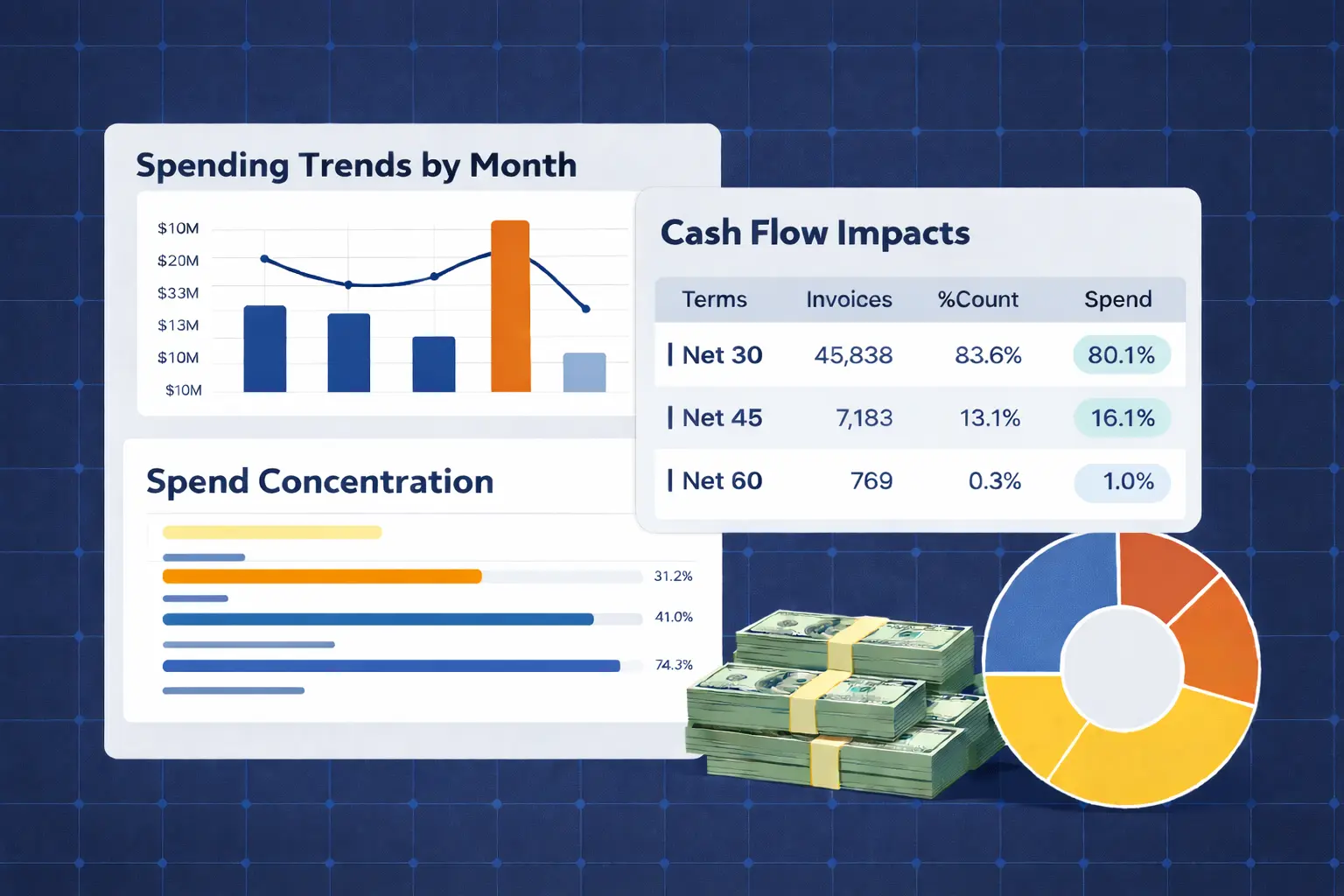
Every vendor relationship in your organization carries negotiated payment terms. Some include early payment discounts that, if captured consistently, would return meaningful cash to the business every quarter. Most of that value never gets realized.
Not because the terms aren’t there, but because the internal steps between invoice receipt and payment don’t move fast enough to capture them.
The gap between negotiated terms and actual payment behavior is one of the most overlooked sources of cash flow leakage in mid-market finance. The dollars are quantifiable. The patterns are already sitting in your invoice data. Most organizations just don’t have a fast way to see them.
Stampli Deep Finance™ is executive spend intelligence that surfaces exactly these patterns, turning invoice, workflow, and payment data already inside Stampli into a focused analysis finance leaders can review and act on.
Where the Money Goes
Consider what’s actually happening between invoice arrival and payment. Your organization negotiates terms with a vendor, say a discount for early payment that represents roughly 36% annualized. Compelling returns by any measure. But capturing that discount requires the invoice to clear approval before the window closes.
For many mid-market organizations, approval cycles routinely run long enough to make those windows unreachable. The discount exists in the agreement. It never reaches the bottom line.
Now multiply that across your vendor base. Some invoices are paid late, not strategically, but because that’s how long it took for the right people to review and approve them. Others are paid earlier than necessary, even when no discount is in place, meaning cash leaves the business sooner than it needs to with no benefit in return. Both patterns cost money. Neither tends to show up in standard reporting.
This is the core tension in AP cash flow management: capturing discounts means paying faster on some invoices, while preserving cash means holding others to full term. These goals aren’t incompatible, but they require knowing which invoices warrant which treatment. Most organizations don’t have that distinction visible in one place.
Taken together, these patterns directly erode working capital without showing up as a single line item anyone is watching. Missed discounts reduce margins. Early payments shrink cash reserves. Late payments strain vendor relationships and trigger penalties. Each one is manageable on its own, but across a full vendor base, the cumulative impact on working capital is significant and largely invisible.
Why Standard Reporting Misses It
The data behind these patterns exists. Payment dates are logged. Terms are recorded. Approval history is tracked. What’s missing is the connected view: how those signals interact across the same vendor base, the same entities, the same time period.
A terms report may say one thing. A payment report may show cash leaving on a different schedule entirely. Approval history may show where an invoice sat for days waiting on a single reviewer. Finance teams end up stitching these answers together manually, if they get to it at all.
There’s another layer most teams miss: governing terms live in the vendor record, or negotiated agreement rather than on the invoice.. A vendor might print “Net 15” on every invoice, but the actual negotiated agreement is Net 30. When payment timing analysis relies on invoice-printed terms rather than the vendor agreement, the whole picture shifts, and cash flow decisions are being made against the wrong baseline.
That’s how working capital erosion hides in plain sight. One vendor population may be creating avoidable cash pressure with short terms. Another may be getting paid well ahead of due dates with no corresponding benefit. A third may carry discount terms your organization has never once captured. No single report shows all three, which is why the working capital impact stays invisible until someone pulls it all together.
What a Deep Finance Analysis Can Surface
Deep Finance analyzes invoice, approval, and payment data already inside Stampli and organizes it into a focused, executive-ready analysis, surfacing the findings worth investigating so finance leaders can see what changed, what matters, and what to do next.
On cash flow specifically, a Deep Finance analysis can surface:
- Uncaptured discount value: the dollar gap between discount terms available across your vendor base and what your organization is actually capturing, broken out by vendor and invoice volume
- Approval delays costing real money: where specific steps in the review process are pushing invoices past discount windows or past contracted terms, and the financial impact of that drift
- Payment timing vs. vendor agreements: where actual payment behavior has diverged from negotiated terms, including where your organization is paying faster than required with no benefit in return
- Cash outflow concentration: patterns in when payments cluster that create avoidable weekly or monthly cash pressure
These aren’t new data points. They’re signals already present in your AP workflow, organized into quantified findings with recommended actions so finance leadership has a clear starting point for follow-up.
From Manual Assembly to Executive Spend Intelligence
Most finance organizations have a version of this analysis. It just often takes days of manual work across the team to produce. A controller pulls invoice history. Someone cross-references payment timing against terms. A CFO asks a pointed cash flow question that requires several exports and several days of manual assembly before the answer is usable.
Deep Finance shortens that path. It turns the workflow data already moving through Stampli into executive spend intelligence: quantified findings, supporting evidence, financial impact, and recommended actions, assembled into a focused analysis rather than a raw data export.
Stampli processes more than $150B in annual spend across its customer base. Deep Finance uses that invoice, workflow, and payment context to help finance teams investigate the questions that matter most to cash flow, without building the analysis from scratch every time.
Human Judgment Still Leads
Deep Finance doesn’t replace finance judgment. It gives the controller, VP Finance, or CFO a stronger starting point: the kind of analysis that helps leadership make better decisions around when to renegotiate terms, where to streamline approval steps, which vendors are creating unnecessary cash pressure, and where early payment opportunities are realistic enough to pursue.
The payment terms are already negotiated. The invoice data is already in the system. The real question is whether that data is surfacing the cash flow opportunities your organization is missing, or just sitting there.
See how Deep Finance turns your AP data into cash flow intelligence.