


A controller closes the books and runs the numbers on AP. The team processed thousands of invoices last month. Most moved through quickly. A handful did not, the ones with split allocations across entities, the one where the vendor changed bank details, the contract invoice that needed a Director’s approval before the GL coding could even be finalized. Those are the invoices that took real time, and those are the ones the “touchless” pitch has nothing useful to say about.
Vendors promise touchless AP: fully automated invoices with zero human involvement. The pitch is simple. And for most organizations, it is incomplete. The idea collapses the moment real complexity enters: multiple approvers, GL allocations across entities, non-standard exceptions, vendor verification, ERP rules. Chasing “touchless” as a goal often makes your AP operation worse, requiring extensive rule configuration that breaks when your business changes.
The honest framing is three-part: automation where it reduces manual work, human control where finance judgment matters, ERP alignment throughout. That is what AP teams actually need, and it is what this post is built around.
This post will cover:
- Why “touchless AP” is the wrong framing for real-world operations
- How rule-based automation differs from AI-driven, ERP-aligned automation
- Where Ramp and Bill’s “touchless” claims hold up and where they fall short
- How Stampli automates the operational work across procure-to-pay while finance teams stay in control of approvals, validation, exceptions, and ERP governance
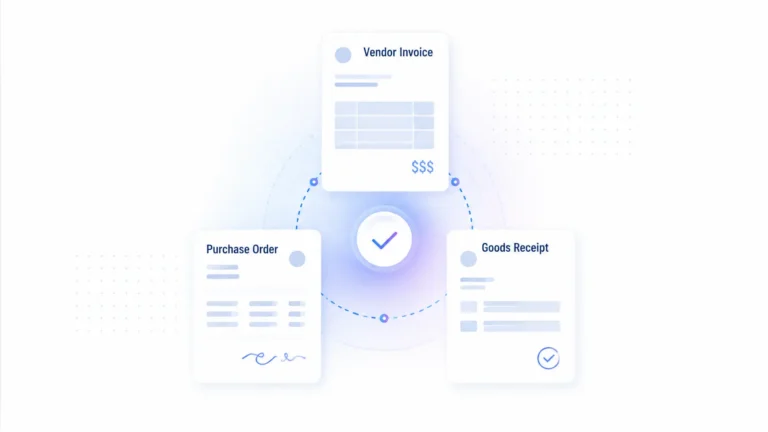
The point is not to remove finance from the process. The point is to free finance teams from grunt work so they can focus on strategy, oversight, and judgment, while preserving the controls a controller is accountable for: 3-way match, segregation of duties, ERP-aligned coding, and a clean audit trail.
The myth of “touchless AP”
What does “touchless” actually mean?
When vendors talk about touchless AP, they describe a simplified scenario. An invoice arrives. It gets coded. It gets routed to the right approver. It gets approved. Payment is made. Nobody on your finance team lifts a finger.
In theory, it sounds perfect. In reality, it is a fundamental misunderstanding of what accounts payable actually is, and what finance teams are accountable for.
Why a real AP process is never fully touchless
Here is what actually happens in a mid-market or enterprise AP operation. It is layered. It involves controls. It requires judgment.
- The verification problem: When an invoice line item arrives, someone needs to verify that goods or services were actually delivered. This is not a data entry task. It requires checking receiving documentation or project records and confirming that what is on the invoice matches what was received.
- The allocation challenge: An expense might need to be split across three departments, two projects, and four GL accounts. The invoice itself does not tell you that. Your business logic does. Someone has to make that decision based on context the system needs to understand.
- The exception handling: Missing PO numbers, pricing or quantity discrepancies, unrecognized vendors, changed banking information, these scenarios emerge constantly in any real business. Handling them requires reasoning, not rule application.
- The complexity multiplier: Now add multi-line invoices, multiple approvers, subsidiary entities, different currencies, and compliance requirements. The moment real-world complexity enters the picture, the notion that an invoice can flow start-to-finish without any human review or accountability becomes unrealistic.
The gap between simple and complex
Here is the uncomfortable truth about “touchless” automation: it works smoothly for trivial scenarios.
If you have a one-line invoice for $500 from a verified vendor that perfectly matches an existing purchase order, yes, it can be auto-approved. That should be automated. It is not interesting or strategic, but it is automatable.
The problem is that in most mid-market AP environments, those trivial cases are a minority of invoice volume. The majority involve multiple approvers, multi-entity allocations, exception handling, or vendor verification. That is where pure “touchless” framing breaks down.
The hidden maintenance burden nobody talks about
When vendors market touchless AP, they often hide something important: the upfront and ongoing manual configuration that happens behind the scenes.
To achieve what looks like end-to-end automation on day one, these systems require extensive rule-based setup. Your team spends weeks or months building if/then statements: “if vendor code = X and amount < $Y, route to approver Z.” It feels like teaching the system your processes.
But here is what happens next. Your organization changes. You hire a new approver. You open a second office. A vendor consolidation initiative merges three vendors into one. Your GL structure gets reorganized. Suddenly every hard-coded rule needs updating. Someone, usually your AP manager, has to go in and reprogram the system.
That is not zero touch. That is just shifting the touches to a backend configuration layer until something breaks.
From rules-based automation to AI-driven, ERP-aligned automation
Yesterday’s automation: the OCR and rules era
To be fair about where we came from, the previous generation of AP automation was genuinely innovative for its time.
These systems could read invoice data using OCR technology. They could apply pre-set rules to route and code invoices. They were significantly faster than purely manual processing. And for straightforward scenarios, they worked reasonably well.
But they were also fundamentally brittle. They could not adapt. They could not learn. They could not handle anything outside the bounds of their programmed rules. As soon as something new emerged, a new vendor format, a new GL structure, an exception scenario, the system either failed or required manual reprogramming.
What AI-driven AP automation actually is
This is where the technology is shifting, and it is worth understanding what is genuinely new.
AI-driven AP automation is fundamentally different from the rule-based systems that came before. Instead of passively applying pre-set rules, it observes patterns, validates against ERP context, and executes the operational work the same way an experienced colleague would, while finance retains accountability for approvals, exceptions, and governance.
In AP, think of it this way. A traditional system is a bureaucrat following a flowchart. AI-driven automation is an embedded assistant that knows your business, understands the patterns, and surfaces the right action for the right person, even when something new comes up. It still hands judgment back to the human at the moments that matter.
The key distinction is continuous improvement against ERP rules. A traditional system stops learning after initial setup. An AI-driven system keeps absorbing patterns from every invoice it processes, every approval it routes, and every correction your team makes.
Why vendors are suddenly talking about “agents”
Recently, companies like Ramp have started popularizing the language of “AP agents” in their marketing. This is a direct response to the limitations of the older rule-based approach. But the agents themselves are often narrow and do not carry the full ERP and operational context that real AP work requires.
The industry has recognized a fundamental problem: without more adaptive AI, automation hits a hard ceiling. Vendors understood they needed to evolve or become irrelevant. So the marketing language evolved.
But marketing has gotten ahead of the product reality.
How competitors are overpromising: Ramp and Bill
Ramp’s “touchless AP” approach and where it falls short
Ramp is an expense and corporate card platform with added AP capabilities, claiming fully touchless invoice processing powered by multiple AI agents.
What they claim:
- 2x faster approvals thanks to AI recommendations
- AI recommendations on invoices with a 90%+ acceptance rate by approvers
- Over 60 fraud signals to catch issues
- The ability to handle multi-line invoices “touchlessly”
What is actually happening:
When you look past the marketing, the picture changes. Ramp’s automation works well for simple cases. One-line invoices. One approver. Tied to a Ramp card transaction. That is the sweet spot.
The moment complexity enters the picture, multiple approvers, multiple GL allocations, non-standard scenarios, the system can struggle. Much of what Ramp markets as AI is rule-based automation that the customer has to pre-configure.
The “2x faster approvals” only happens because static approval routes are set up in advance.
The real limitations:
That 90% acceptance rate on AI recommendations sounds impressive. The remaining 10% are usually the invoices that matter most. Edge cases, high-risk vendors, policy gray areas. At any real volume, finance teams still spend meaningful time reviewing them.
Ramp’s approval and coding logic does not evolve your policies on its own. You can route approvals to roles like “department owner.” But when thresholds, entities, or routing rules change, someone has to go back into the configuration screens. The system needs that manual work to stay aligned with how your business actually runs.
On fraud, Ramp advertises 60+ signals trained on hundreds of thousands of invoices. They say these signals can stop risk before approval. What they do not provide is the hard performance data controllers actually care about. There are no clear false-positive rates, no detection rates by fraud type, and no view into how often the system catches something humans would have missed. From the outside, it looks more like a generic risk filter than a verifiable second set of eyes.
Multi-line and PO-based invoices look polished in the marketing examples. The reality of complex, non-PO, service-heavy invoices is messier. The agents can suggest line-level coding based on history. But accountants still need to audit those suggestions carefully before posting them. That is a long way from “touchless.”
What is happening behind the curtain:
Ramp’s documentation shows administrators setting up if/then rules to “teach” the system. This is not magic. It is the customer doing the heavy lifting upfront. Ramp’s AP automation is more static than adaptive. It is useful for routine tasks in controlled scenarios, but the agents do not carry full ERP and operational context, and they cannot handle the messy middle ground where real judgment is required.
Bill’s AI agents: the promise versus the reality
Bill recently announced a new suite of “intelligent AI agents” with claims of “touchless transactions” across AP, expense management, and vendor onboarding.
What they claim:
- Automatically extract invoice data
- Reconcile receipts to expense reports
- Collect and validate W-9s from vendors
- Accelerate new user onboarding
- Trained on a trillion dollars of transactions and a billion documents
What the product actually does:
The actual capabilities are more limited than the marketing suggests. In AP specifically, Bill’s AI agents extract header fields like vendor details, invoice metadata, and payment terms, but not full GL coding or line-level allocations.
That is useful for data entry, but it stops far short of full invoice processing. The system does not automatically code invoices to the correct GL accounts or departments. It does not handle multi-line allocations. Most coding still requires an AP staffer because the AI is not context-aware enough to choose the right accounts or dimensions.
The W-9 collection fantasy:
Bill’s marketed “autonomous W-9 collection agent” is ultimately a mostly-automated email workflow with basic data checks. It emails vendors requesting W-9s, pulls information off the forms, and tracks who has responded or passed simple validation rules. That is helpful, but it is not an AI calling vendors on your behalf or exercising judgment on tax forms. It is a workflow upgrade dressed up in agentic language.
The onboarding story:
The “agentic-powered onboarding” is essentially a guided setup process for new users in the expense module. It is not an AI that learns your company’s policies. It is a useful workflow, but not intelligent in the way that matters for AP.
The learning question:
The claim about being trained on vast data is conventional, so what matters is whether the AI learns your business. Bill says its AP AI learns from customer behavior, but in practice it often fails to adapt in ways finance teams can actually see. If Bill’s AI miscodes an invoice and you correct it, does it reliably stop making the same mistake next time? The documentation talks about learning from history and corrections, but there is little transparency or control over that learning, and teams still end up fixing the same types of errors by hand.
Scope reality check:
Bill can match expense receipts to transactions when amounts and dates align, saving employees time in expense reporting. In actual AP approvals and validations, there is no autonomous agent deciding whether an invoice is okay to pay. A human still needs to review and approve. Bill might flag obvious duplicates or missing fields, but it is not conversing with approvers or chasing exceptions.
The pattern both reveal
Both Ramp and Bill illustrate something important about the current market: AI features that sound end-to-end in marketing language but are narrow in reality. These solutions handle pieces of the AP puzzle, data capture, simple routing, but do not adapt to the multi-layered workflows that real companies operate.
Finance teams still end up doing enormous amounts of manual work: maintaining rules, correcting AI mistakes, managing exceptions. The efficiency gains plateau quickly because the AI is not aligned to ERP rules, dimensions, and approval structures, and it is not learning the organization’s unique processes.
What is missing from touchless AP framing
Looking at the limitations of these tools, a few things become clear:
They cannot handle real complexity. AP agents work in controlled scenarios with simple structures. Mid-market and enterprise companies have multiple entities, multiple currencies, complex approval chains, and non-standard exceptions. When the AI hits something outside its training, it breaks.
They do not truly adapt. They might improve their generic model over time, but they do not learn your business. They do not understand your vendor relationships, your approval patterns, your exception handling philosophy, your GL structure. They are generic assistants without full ERP context.
They create hidden work. By requiring extensive upfront configuration and rules maintenance, they shift the burden rather than eliminate it. You are not saving time, you are moving where the time gets spent.
They miss the point of AP. Accounts payable is not about achieving a theoretical maximum of automation. It is about freeing finance teams to do work that matters, analyzing spend, building vendor relationships, managing cash flow, while preserving the controls and accountability the business depends on.
Stampli: AI does the operational work, finance stays in control
This is where a fundamentally different approach matters.
Embedded AI across procure-to-pay
Stampli AI is not a feature bolted on top. It is embedded across the procure-to-pay platform, performing the operational work of coding, routing, matching, validation, and ERP synchronization, while your team retains accountability for approvals, exceptions, and governance.
You are not adopting a generic assistant. You are running AI-driven, ERP-aligned automation that is shaped by your vendors, your dimensions, your approval structures, and your historical patterns.
Across our customer base, this is what that looks like in practice: 86% of finance work automated across 2,500+ unique fields, $150B in annual spend processed, and 400K+ invoices a week running through the platform. Coverage hits 100% across those 2,500+ fields, which is what makes ERP-aligned automation possible in the first place.
Why Stampli AI excels at complexity
Stampli AI is built for the complexity where narrow AP agents fall short.
- Multi-line invoices: Whether an invoice has one line or twenty, whether it relates to zero POs or multiple POs, the platform interprets and codes it appropriately. It handles multi-line invoices even without purchase orders backing them, using vendor history, business logic, and ERP context to surface the right coding for review.
- Complex approval hierarchies: The system recognizes when an invoice needs department manager approval and project lead approval, and routes it accordingly. Different invoice types need different approval chains. Complexity does not break the workflow, it is where the platform earns its keep.
- Real-world exceptions: AI handles scenarios that most automation fails on, unusual vendors, non-standard invoices, allocation decisions across multiple GL codes. These are the situations where simpler systems give up.
The point is not to chase 100% touchless. The point is to remove the repetitive operational work while preserving the validation, approvals, and judgment finance is accountable for.
Adapting to your organization
Stampli’s AI improves with every interaction. As it processes invoices, it absorbs the corrections and decisions your team makes. It learns from your ERP data, vendor masters, chart of accounts, historical transactions. It learns from user behavior, how particular vendors are consistently coded, which approvers typically handle certain invoice types, what exceptions your team treats as normal.
Over time, the system’s suggestions and routing become increasingly aligned with your organization’s patterns. When something changes, the system adapts naturally, no manual rule rewrite required.
This adaptability shows up in real-world results. Colin Madden, Controller at The Pines at Davidson, shares: “Stampli has helped our efficiency. The suggestions, especially the more that we’ve used the system, are almost always right. It saves time without having to search for the GL accounts or the other different codings that we use. To see what we’ve used in the past and see the suggestions and just click them, that’s been a great time saving.”
How Stampli approaches approvals differently
Approvals are dynamic, not static.
Traditional systems say: “Invoice type X always goes to Approver Y.” Stampli says: “This invoice from ABC Supplies should go to Jane in Ops because she has approved the last five invoices from that vendor, and these typically go to Jane before they reach Mark in Finance.”
Stampli surfaces context and reasoning with its recommendations. Approvers understand who the invoice is going to and why. That builds confidence. And because the platform is learning your patterns, recommendations get more accurate over time.
This reduces the time AP staff spend figuring out routing. Approvers trust the system because they are not getting invoices sent to them at random, they are getting invoices that match their historical authority and ownership.
Proactive risk management built in
Stampli does not just process data. It actively protects your AP process.
- Duplicate detection: As invoices enter the platform, the system automatically checks against all invoices in your ERP and Stampli to identify potential duplicates before they ever reach approval.
- Vendor verification: Vendor management capabilities ensure that vendor banking and profile updates are reviewed and verified by authorized users, protecting against accidental or fraudulent changes.
- Compliance monitoring: Stampli lets you block payments to non-compliant vendors, set document expiration alerts, and require submission of forms before an invoice moves forward.
Unlike tools that flag risks after payments are sent, Stampli is designed to catch issues early, before commitment, when control is still possible.
How AI and humans actually work together in Stampli
Here is the principle at the center of the platform: AI and humans work in tandem, not in replacement.
The platform automates the heavy lifting, data entry, coding, routing, validating routine details, which frees your team to focus on exceptions and strategic work. Your team is always in control. Nothing gets paid without appropriate approval. Every action and recommendation is captured in a full audit trail, so you can always see why the system suggested something. When the AI is not confident, it flags the item for human review rather than guessing.
The philosophy is simple. AI should eliminate drudgery, not decision-making. The goal is efficiency without sacrificing accuracy or governance. Automation where it reduces manual work. Human control where finance judgment matters. ERP alignment throughout.
The Stampli difference: complexity and AI working together
Many solutions force a choice. Either you get sophisticated processes with weak AI, or you get flashy AI that only works if you simplify everything. It is a false binary.
Stampli is built to handle both. You get a flexible AP platform that supports multiple entities, multi-currency operations, layered approvals, and complex allocation rules, the operational reality mid-market and enterprise companies actually run on. Layered into that, you get embedded AI that adapts to that complexity rather than being limited by it.
That matters because you do not have to compromise. You do not have to strip down your controls to enable automation. You do not have to sacrifice policy nuances to make AI work. The platform adapts to your process. Your process does not bend to fit the AI.
That is a meaningful difference when you are trying to maintain governance while pursuing efficiency.
Rethinking AP transformation: beyond the touchless myth
The real goal of AP automation
The goal of AP automation is not to achieve some mythical state of zero human involvement. That is not the point.
The real goal is to maximize automation where it makes sense and minimize human effort on low-value tasks while preserving the validation, approvals, and governance finance teams are accountable for. The ROI is not in achieving some percentage of “touchless” invoices. It is in freeing your team from repetitive processes so they can do work that matters, while keeping control of the AP process.
That is the distinction.
What this means for your AP team
The end goal of all this technology is to empower your finance team. The future is not zero-touch AP. It is better-allocated AP work.
It is an AP process where your team intervenes only where they uniquely add value. Reviewing an exception. Validating an unusual allocation. Building vendor relationships. Analyzing spend trends. Making strategic decisions about cash flow and vendor risk. They handle the judgment calls.
The repetitive grind, data entry, routine coding decisions, basic matching, runs through the platform.
When your AP team is freed from that work, the role changes. From data processors to process managers and strategists. The team gets to think more deliberately about vendor relationships, spend optimization, and risk. That is not job elimination. That is job elevation.
Learn more about the Stampli AI-driven procure-to-pay platform here.