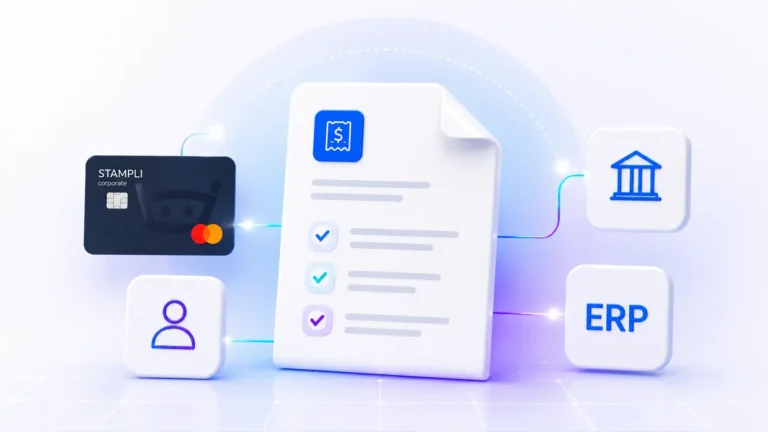




Card-only expense workflows can work well when a company needs a fast way to issue cards and set basic limits. But a card swipe is not a completed finance process. As transaction volume, entities, policies, and reporting needs grow, finance still has to collect receipts, confirm coding, review exceptions, route approvals, and prepare the transaction for the enterprise resource planning (ERP) system.
That is when a team has outgrown a card-only expense workflow. The issue is not that corporate cards are wrong. It is that a card program alone is built around the payment method, while finance has to manage the work that follows it.
Why card-only expense workflows break
Corporate cards give employees a convenient way to make approved purchases. They can also give finance useful controls at the point of spend, such as cardholder limits or merchant-category restrictions. Those are valuable guardrails. Stampli Card is designed to keep card issuance, approvals, coding, and transaction visibility connected to Procure-to-Pay.
They do not, by themselves, turn a transaction into a finance-ready expense. After the swipe, someone still needs to establish what was purchased, attach the receipt, determine the appropriate general ledger (GL) account and dimensions, verify policy context, obtain the right approvals, and make sure the expense can be recorded correctly.
The gap often stays manageable while a business is small or its card spend is simple. It becomes much harder to ignore when:
- More employees use cards across departments or entities.
- Expenses need project, department, location, or class coding.
- Finance has to distinguish ordinary transactions from exceptions.
- Card spend and employee-paid reimbursements are handled in separate systems.
- Month-end reconciliation depends on manual follow-up.
In that environment, the better question is not, “Do we need corporate cards?” It is, “Can our expense workflow carry every transaction from submission through finance review and ERP posting?”
| Card-only expense workflow | Finance-ready expense workflow |
|---|---|
| Focuses on card issuance, limits, and transaction feeds | Connects company-card expenses and employee-paid reimbursements to one finance workflow |
| Leaves finance to collect missing receipts and business details | Keeps receipts, policy context, comments, and exceptions with the expense record |
| Gives AP incomplete information after the swipe | Supports review, coding, approvals, payroll preparation, ERP readiness, and audit evidence |
| Treats reimbursements as a separate process | Applies consistent finance control across two different spend paths |
Five signs you have outgrown cards
Receipt chasing becomes routine
Missing receipts are one of the clearest signals that card-only expense workflows have reached their limit. The transaction may appear quickly, but finance still needs documentation and business context before it can complete the record.
When receipt collection happens through email reminders, spreadsheets, or a separate tool, the work becomes fragmented. Finance has to connect a card feed to a receipt, an employee explanation, a policy decision, and the resulting accounting treatment. The longer those items remain separate, the more time the team spends resolving a basic transaction record.
An expense management workflow should make receipt capture part of moving the expense forward, not a cleanup task at the end of the month. It should also keep comments, supporting documents, coding, approvals, and exception status attached to the same expense.
Coding happens after the close begins
Many teams first feel the limits of corporate card expense management when transactions arrive in the ERP with incomplete or unreliable coding. A card program can identify the merchant and the cardholder. That does not necessarily supply the GL account, cost center, entity, project, or other dimensions the business uses to account for the spend.
If AP or accounting must reconstruct that information later, the transaction becomes an investigation. The employee may not remember the business purpose. The manager who knows the project may not be in the review path. And finance may be forced to make corrections after the expense has already appeared in downstream reporting.
ERP coding works best when the accounting context is gathered while the expense is still moving through review. That does not mean the expense tool replaces the ERP. The ERP remains the system of record. It means the expense workflow should use the accounting structure and business rules finance relies on before the expense is prepared for posting.
Approvals lack business context
An approval is not meaningful merely because it occurred. The approver needs enough context to decide whether the expense is appropriate, correctly categorized, and consistent with the relevant policy or budget expectations.
Card-only workflows often make it easy to set a spending limit but harder to preserve the explanation behind a transaction. That can leave approvers reviewing a merchant name and an amount without the receipt, business purpose, coding, or conversation needed to make a useful decision.
Effective expense approval workflows route the right expense to the right person with the relevant information attached. Routing may depend on amount, department, entity, expense type, or other business rules. The goal is not to add approvals for their own sake. It is to make review practical before a transaction becomes a downstream correction.
Reimbursements live in a separate lane
Company-card transactions are only one form of employee spend. Employees also make out-of-pocket purchases, submit mileage, and request per diem reimbursements. When the card program and reimbursement process are separate, finance gets two incomplete pictures of employee expenses.
That split creates practical problems:
- Policies may be applied differently to card spend and employee-paid spend.
- Employees have different submission experiences for similar expenses.
- Finance cannot easily see outstanding expenses across both paths.
- Reimbursement requests may require manual preparation before payroll.
- Audit documentation is scattered across tools and inboxes.
The answer is not to treat reimbursements as card transactions. They start differently and have a different payment path. A connected expense management workflow should let finance review employee-paid spend before reimbursement money moves, then prepare approved reimbursements for the company’s payroll process. It should bring that work into the same review, coding, approval, and audit framework used for company-card expenses.
AP should not inherit cleanup
A finance team has outgrown a card-only approach when AP review becomes the backstop for everything the card workflow did not capture. AP may have to resolve duplicate or overlapping charges, find missing documentation, request coding, confirm approval authority, and determine whether a transaction is ready for the ERP.
That is not a problem AP can solve with faster data entry. It is a workflow-design problem. The information needed to process the expense should be connected to the expense before it reaches a final accounting handoff.
This is where accounts payable automation and expense management should reinforce one another. AP needs a reliable record of what happened, why it happened, who reviewed it, and how it should be accounted for. A card feed without that context can create more downstream work, not less.
Month-end close exposes the real cost of disconnected expense workflows. Finance must confirm that transactions are complete, appropriately coded, approved, and recorded in the right period. If receipts, approvals, and expense details live outside the accounting workflow, the team has to reconcile the gaps under deadline.
Common symptoms include recurring reclassifications, unexplained card balances, late requests for employee details, and delayed reimbursement preparation. None of those issues necessarily mean the card program failed. They mean the workflow around it did not preserve the context finance needs.
For a broader view of the controls that should happen before a card charge and before ERP posting, see corporate card spend controls. This article addresses the next decision: when employee expenses need a connected post-swipe and reimbursement workflow, not only card controls.
What a finance-ready workflow includes
When evaluating expense management software, look beyond card issuance and transaction feeds. A finance-ready workflow should support both company-card expenses and employee-paid reimbursements, while recognizing that their starting points differ.
For each expense, finance should be able to work with:
- Receipt capture and a clear business purpose.
- Policy context and visible exceptions.
- Suggested or confirmed GL and dimensional coding.
- Approval routing that reflects the business’s rules.
- AP review for transactions that need additional attention.
- A complete record of documents, comments, changes, and approvals.
- Preparation for payroll or ERP processing, with the ERP remaining the system of record.
Stampli Expense Management is designed around this finance work. It brings company-card expenses and employee-paid reimbursements into one workflow, so the card swipe or reimbursement submission is the beginning of a connected process, not the end of it. Stampli AI can help prepare expense details for review and suggest coding while finance retains the final decision.
For teams that need spend controls before commitment as well as a connected employee-expense process afterward, Procure-to-Pay creates a broader operating framework. The right design depends on how your organization buys, spends, reviews, and records transactions.
Choose the workflow, not just the card
Corporate cards can remain an important part of employee spend. The question is whether the system around them gives finance what it needs after the swipe.
If receipt chasing, manual coding, disconnected reimbursements, and month-end cleanup have become normal, your company has likely outgrown card-only expense workflows. Look for an approach that lets employees submit easily while giving finance the context to review, approve, prepare, post, and audit every expense.