Tipalti vs BILL vs Stampli: Which financial automation platform is right for you?

Tipalti, BILL, and Stampli provide procure-to-pay (P2P) solutions that automate and connect the complete purchasing cycle from request to reconciliation. These platforms help businesses streamline procurement workflows, accelerate invoice processing, eliminate manual handoffs between departments, and gain real-time visibility into spending commitments.
Modern P2P solutions are also valuable strategic resources. They give you complete spend control, proactive budget management, and procurement visibility that enables better cash flow decisions and business growth.
In this article, we compare the three solutions to help you choose the best P2P platform for your business. We’ll examine industry ratings, customer reviews, features, and users’ experiences with each solution’s ability to connect procurement and accounts payable processes.
Criteria for choosing a P2P automation solution
P2P automation solutions orchestrate the entire procure-to-pay process from purchase requests through payment processing. They automate procurement workflows, purchase order creation, invoice processing, approval routing, and payment execution.
The best P2P solutions excel in six key areas:
- Procurement request and approval workflows: Intuitive purchasing portals with guided forms that apply policy and budget rules automatically, routing requests to the right approvers with minimal friction.
- End-to-end P2P orchestration: Seamless handoff from approved requisition to purchase order (PO) creation to invoice capture and three-way matching to payment execution to reconciliation, eliminating manual data entry and process silos.
- Payment flexibility and controls: Multiple payment options (ACH, virtual/physical cards, wires, checks) with scheduling, batching, FX management, and spend-limit enforcement that gives finance teams maximum control without restricting vendor choice.
- Real-time budget visibility and spend analytics: Dashboards showing committed spend (POs and approved requests), pending invoices, and actual payments against each cost center in real time, preventing budget overruns and providing actionable insights.
- Vendor management and collaboration: Secure vendor portals for onboarding, document collection, invoice submission, and two-way messaging tied directly to each transaction, reducing inquiry volume while ensuring compliance.
Tipalti vs BILL vs Stampli: At a glance
If you’re evaluating Tipalti and BILL, you’ll likely find you’re really choosing between a global payments specialist (Tipalti) and a small-business accounting platform (BILL).
Let’s introduce another option. Stampli removes the need for that trade-off by giving finance teams a true end-to-end procure-to-pay workflow, without the implementation headaches or feature gaps the others create.
| Criteria | Tipalti | BILL | Stampli |
| P2P coverage | Payment-focused with some procurement add-ons | AP/AR only — no procurement features | The only solution that connects every dot of the P2P process |
| Implementation | Advertises weeks, but customers report months of delays and issues | Quick setup for basic features, but limited scalability | Implementation takes days to weeks, with user reviews consistently backing that up |
| ERP integration | Customers report chronic sync issues and broken connections | Basic integrations with frequent disconnect problems | 70+ native integrations that work seamlessly from day one |
| Payment flexibility | Strong international payments, but requires pre-funding accounts | Limited payment options with per-transaction fees | ACH, cards, wires, checks — no vendor restrictions or hidden fees |
| User experience | Steep learning curve and complex navigation | Simple for small teams, but 1/10 usability rating on some review sites | Industry-leading usability ratings across all user types |
At a glance you can see where each platform excels — and where gaps appear:
- Tipalti can handle complex international payouts and tax compliance, but its troubled implementation process and glitchy enterprise resource planning (ERP) integrations leave many mid-market firms struggling with basic connectivity.
- BILL offers simple setup for small businesses, but its lack of procurement features and poor customer support make it inadequate for growing companies that need true P2P capabilities.
- Stampli delivers the complete request-to-reconciliation loop with the speed, reliability, and usability that finance teams need to scale efficiently.
But don’t just take our word for it. Let’s see what the experts say.
Industry ratings for procure-to-pay solutions
The G2 Satisfaction Score for P2P Automation measures customer satisfaction based on reviews from existing customers. Unlike traditional AP-only solutions, P2P platforms manage the complete purchasing cycle from procurement requests through final payment and reconciliation.
The rating evaluates how well procure-to-pay solution providers satisfy users’ needs by measuring results in four categories:
- Implementation: How easily can you implement the solution?
- Usability: How easy is the solution to use?
- Relationship: How well does the solution provider build customer relationships?
- Results: How well does the solution deliver results?
Implementation index
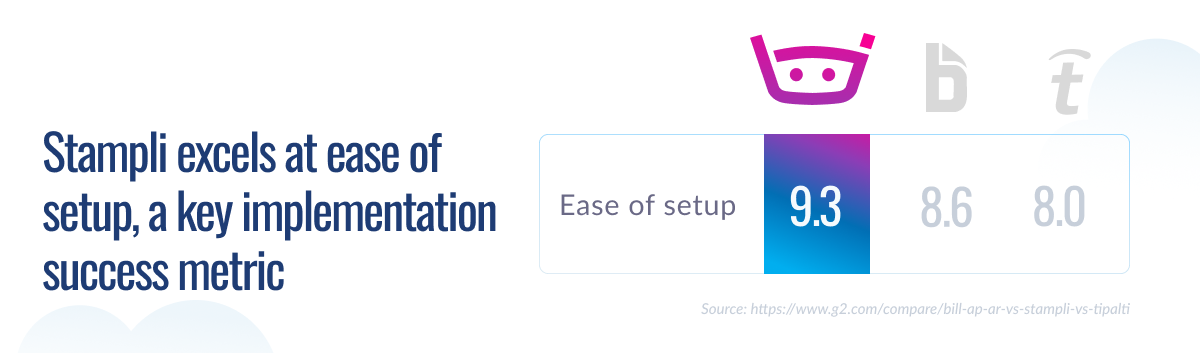
The Implementation Index measures customers’ satisfaction with implementing and beginning to use a new P2P solution. It comprises three factors:
- Ease of setup
- User adoption
- Time to go live
Of the three providers, Stampli scored significantly higher in ease of setup and user adoption, indicating it is the easiest solution to implement. Stampli also scored higher than the P2P automation industry average for time to go live — reinforcing its industry-leading reputation for fast deployment, implementation, and user adoption.
Usability index
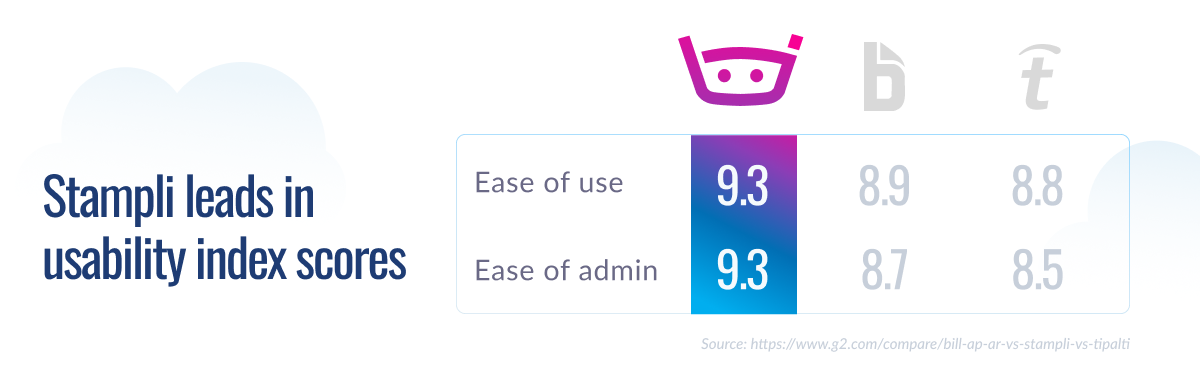
The usability index evaluates customer satisfaction with each P2P solution’s user interface and functionality. It measures two factors:
- Ease of use
- Ease of admin
Stampli leads the Usability Index, scoring higher than Tipalti and BILL for ease of use and ease of admin — a strong endorsement of Stampli’s “designed for procure-to-pay” user interface and platform.
Relationship index
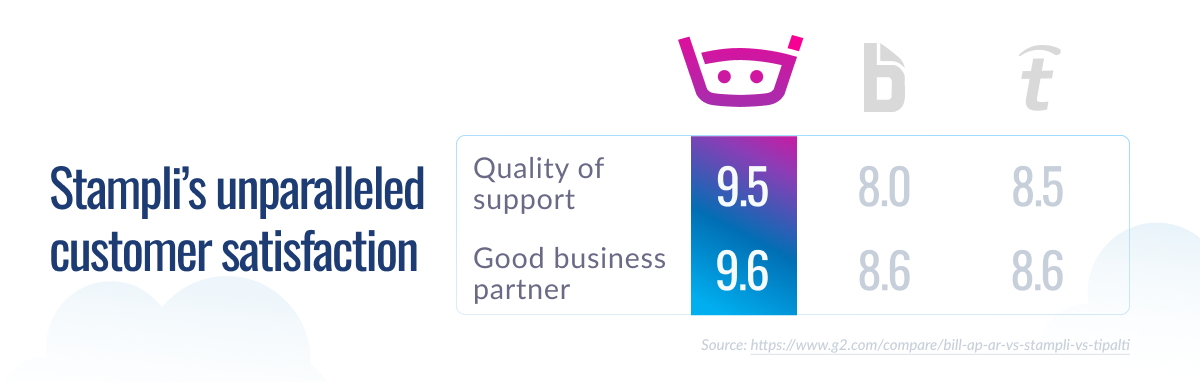
The relationship index measures customer satisfaction by assessing how well each supplier manages the business relationship. It consists of three factors:
- Likelihood to recommend
- Ease of doing business
- Quality of support
Stampli achieved the “Best Relationship” ranking, receiving industry-leading ratings for quality of support, ease of doing business, and likelihood to recommend, indicating a high probability that Stampli users would endorse the platform to a colleague.
Results index
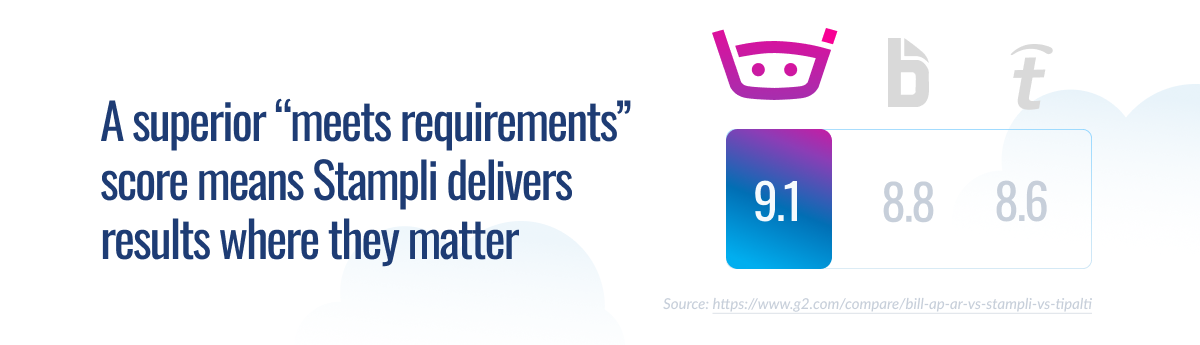
The results index evaluates the bottom-line impact of working with each supplier. The index measures two factors:
- Meets requirements
- Estimated ROI
Stampli earned one of the highest “Best Results” scores for its estimated return on investment. In the meets requirements category, Stampli scored higher than Tipalti and BILL, reflecting how well Stampli’s P2P automation consistently delivers business results for customers.
By comparing each P2P automation provider’s Satisfaction scores, you can quickly identify the product that provides the best customer experience based on feedback from actual users. Now, let’s dig deeper into each competitor’s strengths and weaknesses as reported by customers on G2, TrustRadius, GetApp, Capterra, and Software Advice.
Tipalti: Balancing power vs complexity
Tipalti is a comprehensive P2P platform that combines global payment automation, AP automation, and procurement management capabilities. Originally focused on mass payments, Tipalti has expanded into a full P2P solution aimed at modernizing and scaling the entire procure-to-pay process.
Tipalti key features
Tipalti aims to meet the needs of small, medium, and enterprise-level businesses wanting to streamline financial processes. According to customers, its advantages include comprehensive payment automation, global supplier networks, and procurement intake management.
Tipalti’s cloud-based platform supports global payments, procurement and expense management, and other P2P processes.
Core features include:
- Global vendor payment processing and foreign exchange risk management
- Purchase requisition and approval workflows with budget controls and procurement intake management
- Automated invoice scanning and data entry, receipt and PO matching, payments, and reconciliation
- Connects procurement requests to AP processing for end-to-end visibility
- Automated enforcement of financial controls, regulatory compliance, payment audit trail, error detection, and role-based security
- Self-service vendor onboarding, data collection, and centralized supplier relationship management
Pricing
Tipalti charges a monthly fee for access to its basic platform. It requires customers to pre-fund payment accounts and charges additional fees for added modules, features, and advanced functionality.
Tipalti advantages
Here are the reasons customers say they have chosen Tipalti as a P2P automation solution.
Expansion into global markets
Tipalti promotes its payment processing solution to help businesses reduce the complexity of paying overseas suppliers. It offers a centralized payment platform, processing payments to 196 countries, foreign exchange tools, and a variety of payment methods.
Many users mention Tipalti’s global payments solution as one of the platform’s top strengths, commenting, “As a mid-sized business with a global supplier base, we found that Tipalti has been instrumental in streamlining our payment processes.”
However, Tipalti requires customers to pre-fund their Tipalti payment account before they can pay vendors, a policy that one customer described as a con.
Customers who want to make payments faster without tying up their money should consider a more flexible solution like Stampli Direct Pay.
One customer describes how Stampli has made vendor payments faster, “We are a Construction Company and must submit Bank draws to fund our payments. That entire process was shortened by three days in our first month just because our Approvers found [Stampli] simple to use and Reviewing invoices was no longer something they dreaded.”
Comprehensive P2P workflow with complexity trade-offs
Tipalti offers a P2P solution with procurement intake, approval workflows, and payment processing. The platform provides customizable options such as a brandable supplier portal, automated vendor communications, and custom approval routing.
While Tipalti markets itself as a comprehensive P2P solution, customers report that their procurement module feels less mature and deeply integrated compared to purpose-built P2P platforms. Unlike Stampli’s unified P2P approach where procurement and AP are built on the same foundation, Tipalti’s P2P capabilities appear to be separate modules stitched together, potentially creating the same handoff gaps that plague other multi-vendor solutions.
Some customers complained of difficulty navigating its features, saying “it can take some time to understand all the functionalities and features available.”
Tipalti’s steep learning curve was also “[o]ne of the things that I liked the least,” for users, with one customer saying, “it can be a bit overwhelming to get familiar with all the features and functionality of the platform.”
Stampli eliminates this disconnect by offering true end-to-end P2P automation built on a single platform. As one Stampli customer explains, “The platform is incredibly intuitive — invoices flow smoothly, approvals are streamlined, and it has saved our team a lot of time compared to our old manual processes. The AI-driven features and collaboration tools cut down on back-and-forth emails and help keep everything organized in one place.”
Customer support with implementation complexity
Many existing Tipalti customers say they like the quality of its customer support team, which one user described as “always kind and attentive.” However, other reviewers mention frustrations with Tipalti’s support on complex issues and implementations.
Tipalti’s P2P implementation complexity is compounded when deploying both procurement and AP modules. Customers report that configuring the full P2P workflow can take significantly longer than promised, with one frustrated customer describing their support experience as “terrible,” complaining that “Onboarding was incomplete and long,” and that it “takes weeks to resolve issues.”
Stampli’s unified P2P architecture means faster, simpler implementation. “Customer support in this process has been outstanding,” one customer says of their P2P implementation experience.
Tipalti disadvantages
Here are some of the difficulties Tipalti customers have identified with the platform.
Challenges integrating Tipalti with ERPs
Many user reviews complain about difficulty integrating Tipalti with ERPs and accounting systems. One customer complains that Tipalti promised smooth integration but didn’t deliver,, “We had a ton of issues with our connection between Teampay/Tipalti/NetSuite. We were sold Tipalti and Teampay as a package deal, and they definitely have not lived up to the promise.”
Other customers report connectivity issues that persist even after years of use. One customer says that chronic sync issues integrating Tipalti with NetSuite are “The biggest drawback from my experience with Tipalti, which I relied on so much but it constantly failed to sync billing PDFs with NetSuite which caused a lot of inconveniences.”
Broken integrations can cause headaches and bring your P2P processes to a standstill. Unlike Tipalti, Stampli exceeds customer expectations for smooth ERP integrations.
Users praise how Stampli “provides a single source of receiving and processing ALL of our bills into one platform and syncing with NetSuite. We no longer have ‘exceptions’ with our complicated processes that a platform cannot handle.”
Slow or difficult P2P implementations
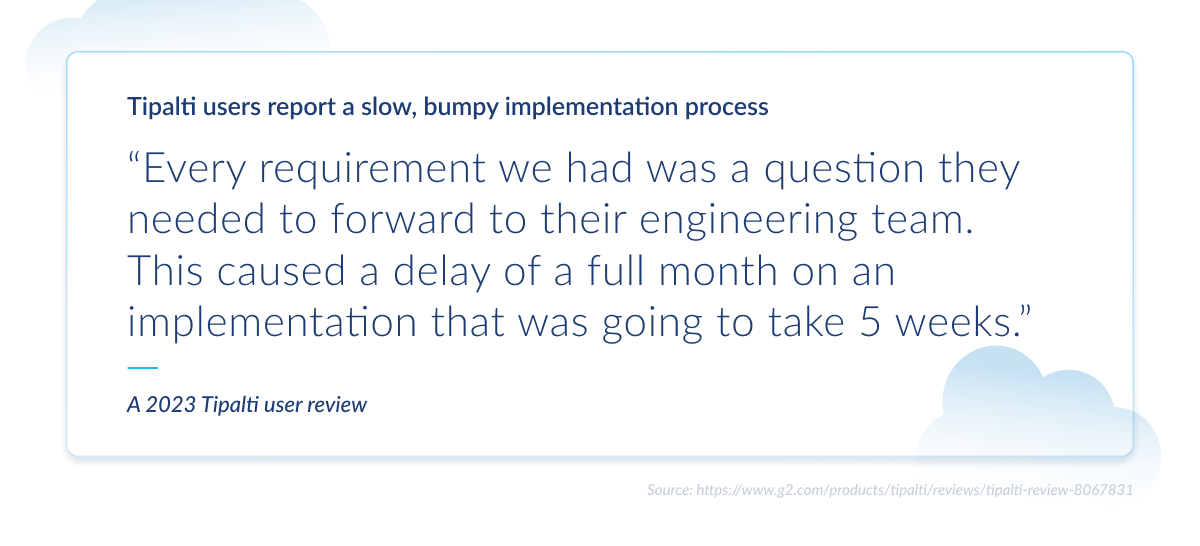
Several users report slow or difficult implementations with Tipalti, particularly when implementing the full P2P workflow. “We started out our implementation with one consultant who simply could not deliver,” one customer reports about a Tipalti implementation going off the rails. “Every requirement we had was a question they needed to forward to their engineering team. This caused a delay of a full month on an implementation that was going to take 5 weeks.”
You only get one chance to make a first impression, and a bad implementation isn’t a great way to start a business partnership. Fortunately, Stampli is the industry leader in fast and painless P2P implementation.
“We were up and running within weeks of signing our contract,” says one Stampli customer. “The few times we’ve had to reach out to support, we are chatting with a real person within 1 minute. We integrate with NetSuite, and that works perfectly.”
The bottom line: Tipalti offers broad P2P capabilities but with complexity trade-offs
Tipalti’s evolution into a comprehensive P2P platform makes it attractive for companies needing global payment processing combined with procurement controls. However, the platform’s complexity, lengthy implementations, and less-than-seamless integration between procurement and AP modules suggest there may be better choices for businesses seeking a truly unified P2P experience.
If you’re looking for a purpose-built P2P solution that connects every dot from request to reconciliation without forcing process changes, Stampli delivers the unified workflow that Tipalti’s modular approach struggles to match.
“My experience with Stampli has been excellent!” says one Stampli customer on Capterra. “They have provided answers to any questions that I have had and always give me solutions for any issues very quickly. They have superb customer service and the software is extremely user friendly!”
BILL: Sacrifices for the sake of simplicity
BILL (formerly Bill.com) is a cloud-based AP and AR automation platform primarily designed for small businesses, with recent attempts to add basic procurement capabilities. While BILL launched a “Procurement” module in Q1 2025, it remains fundamentally an AP-first tool with significant gaps in true procure-to-pay functionality.
BILL key features
BILL has automation features for accounts receivable, accounts payable, electronic payment processing and billing, credit cards, and expense management to help small businesses manage their cash inflows and outflows.
Limited procurement capabilities
BILL’s new procurement module (available as an add-on for Team+ plans) offers only basic purchase request forms and single-step PO creation within BILL’s interface.
However, it has significant limitations:
- No real-time budget enforcement: Requests aren’t validated against budgets at approval time.
- No ERP-synced POs: Purchase orders remain isolated in BILL and don’t sync back to your ERP for true three-way matching.
- Single-approver limitation: Lacks multi-level, conditional, or department-specific approval workflows.
- Manual PO-to-invoice matching: No automated three-way matching between purchase orders, receipts, and invoices.
Pricing
BILL pricing includes both monthly subscription fees and per-transaction charges. Hidden costs can include procurement add-on licensing, additional fees for multiple payment methods, and escalating transaction fees as volume grows.
BILL offers a tiered pricing structure with different feature sets:
- Essentials ($39/user/month): Choice of accounts payable or accounts receivable services, basic automation features, manual CSV integration with QuickBooks and Xero, standard user roles.
- Team ($49/user/month + $0.40/transaction): Both AP & AR, procurement add-on available, advanced approval workflows.
- Corporate ($79/user/month + $0.30/transaction): Advanced features, API integrations, multi-entity support.
- Enterprise (custom pricing): Advanced customization, procurement “Elite” package available at additional cost.
BILL advantages
Scalable solution for small businesses
BILL offers flexible service options to add features like accounts receivable or file-based ERP integration as businesses grow. It provides access to advanced features like customized approval workflows and user roles at higher tiers. One BILL customer says, BILL helps “streamline our payments [through] one service — making accounts receivable easier for both customers and the businesses.”
Although BILL bills itself as a scalable solution for small businesses, some customers have experienced glitches with the platform, saying it “[f]requently goes out of sync,” and that “receivable control [was] not as integrated as payables.”
As your business grows, so will your P2P automation needs.
To handle large numbers of invoices and purchase requests, you need a robust platform. “Stampli has allowed our manual AP process to be automated…which is significant considering the incredible growth we are seeing in our company,” says one fast-growing mid-market business. “It has allowed for greater control and insight into company expenditures as well as reporting features that have been useful for our CFO and CEO.”
Basic payment processing capabilities
BILL offers access to electronic payment methods like wire transfers, ACH, and virtual cards. However, some customers complain about BILL’s practice of “encouraging” customers to pay vendors by virtual card via BILL’s ePayments network, which forces vendors to pay card processing fees.
There are better payment solutions for growing businesses, especially since BILL charges a per-transaction fee. Stampli is a cost-effective and flexible payment solution that won’t force you to choose payment methods.
“Another deciding factor for our company in choosing Stampli over a competitor we looked at was that Stampli’s Direct Pay feature (ACH payments to vendors) is free to vendors without being expensive for us, either,” says one customer.
“I like that Stampli understands businesses of today,” says another reviewer, who loved that Stampli has “the option to pay invoices 3 ways!! ACH, outside stampli (using credit cards or paying in portals) and checks and even expedited checks.”
Ease of use for basic tasks
Customers say BILL is easy to set up for basic AP/AR functions and provides good training for employees. One reviewer comments, “I am using BILL on a day-to-day basis, and the user interface is so simple.”
However, other reviewers are highly critical of BILL’s ease of use. It only received a 1 out of 10 rating for ease of use on TrustRadius, where one frustrated user comments, “I feel like I am about to quit before I do an hour of work.”
Stampli customers praise the platform’s accessibility and ease of use. “I love how easy and efficient Stampli has made our A/P process,” says one happy customer. “It has cut back 80% of our processing time and significantly improved our accuracy.”
BILL disadvantages
Companies outgrow BILL for P2P needs
BILL’s procurement doesn’t connect to their AP process, which means many companies ultimately need to add additional tools or switch platforms as their needs grow more complex. There’s also a gap between BILL and the ERP. Purchase orders never sync, preventing true 3-way matching and real-time spend visibility.
In addition, there’s no upstream spend control. Without real-time budget checks, companies can’t prevent overspend at the request stage.
As invoice volumes exceed 500+ per month, BILL’s manual processes and per-transaction fees become cost-prohibitive.
Unresponsive customer service
Multiple users across review sites complain about the poor quality of BILL’s customer support, saying BILL shows, “complete disregard for their users.” Customer complaints include long response times, sometimes stretching into weeks.
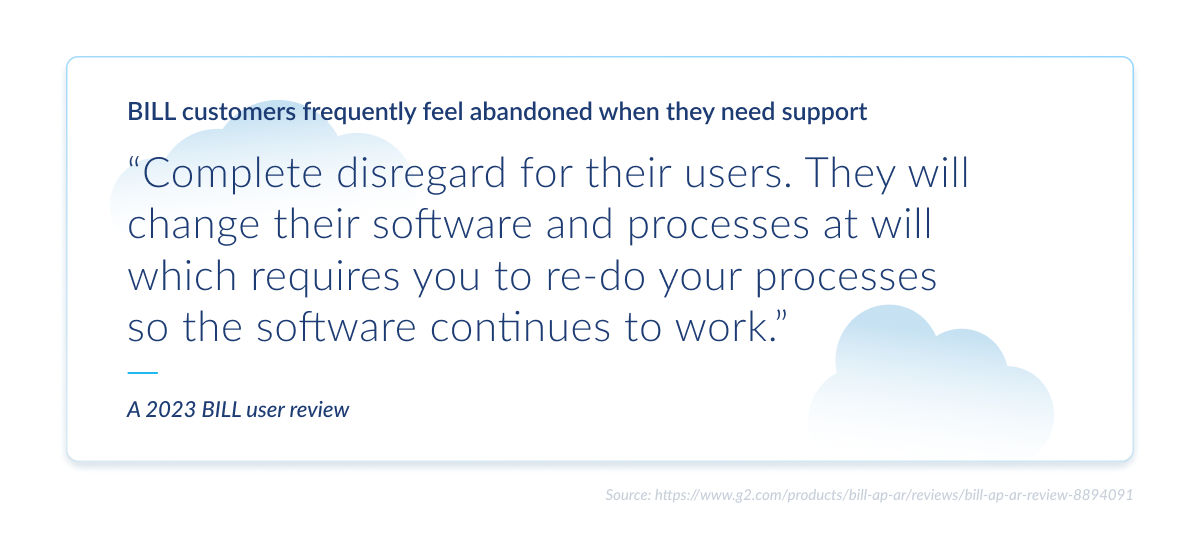
One TrustRadius reviewer says dealing with BILL customer support was a “terrible experience that has really damaged my business.”
You can’t afford poor customer support when you need to run efficient P2P processes. Unlike BILL, customers recognize Stampli for its excellent customer service.
“What I love about Stampli is its transformative efficiency in invoice processing,” says a Stampli user. “Our Customer Success Manager, and the entire Stampli support team, have been outstanding — prompt, collaborative, and attentive.”
Integrating BILL with ERPs can be hard
Many BILL customers complain about difficulty integrating with ERPs and accounting software. Common complaints include chronic synchronization errors with QuickBooks Online, Sage Intacct, and NetSuite.
The bottom line: BILL leaves P2P gaps that growing companies can’t ignore
BILL’s recent procurement add-on addresses only the surface of P2P automation. Companies needing true end-to-end procurement control — from budget-validated requests through ERP-synced POs to automated invoice matching — will find BILL’s fragmented approach creates more work, not less.
Stampli’s P2P Alternative:
- Unified workflow: Purchase requests, multi-level approvals, PO creation, invoice processing, and payments in one system.
- Real-time budget controls: Block or flag requests exceeding departmental budgets at submission time.
- Deep ERP integration: 70+ connectors with real-time two-way sync, supporting complex multi-entity setups.
- Transparent pricing: Flat monthly fee with unlimited users, vendors, and payment methods — no per-transaction surprises.
“You can tell that Stampli has been designed and improved by AP professionals,” says one Stampli customer. “Every time you think ‘it would be really nice if…’ Stampli probably addresses that.”
Stampli: The complete procure-to-pay choice that connects every dot
Stampli is the only P2P platform that connects every dot, from first request to final reconciliation. Unlike one-size-fits-all suites, Stampli layers on top of your existing enterprise resource planning (ERP) system and lets each customer decide how simple or sophisticated every workflow needs to be.
Stampli key features
Stampli helps finance teams control the entire P2P process through intelligent procurement automation, touchless invoice processing, automated approvals, and seamless payment management.
By connecting procurement with accounts payable workflows, it improves working capital management and gives finance leaders complete visibility into spending from request to reconciliation.
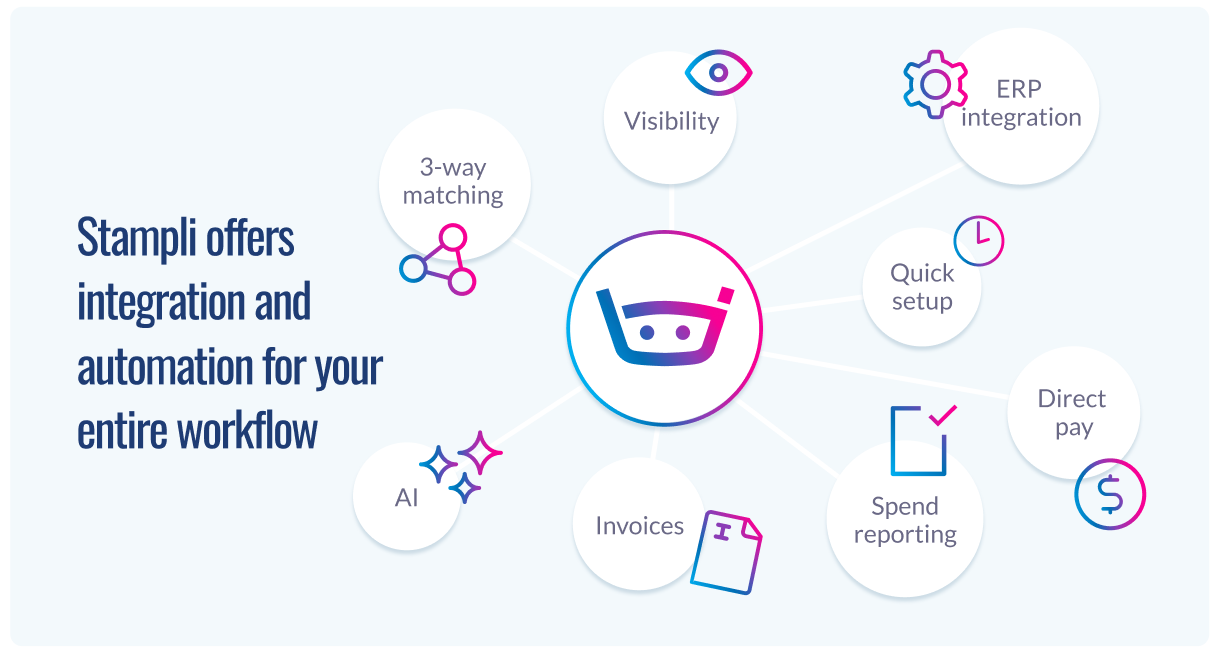
- Complete procurement automation: Employee purchasing portal with natural language request forms, Billy your AI employee to structure requisitions, six pre-built request templates (general purchase, travel, IT hardware, software, office supplies, service tickets), and custom request types.
- Flexible fulfillment outcomes: Any approved purchase request can generate multiple execution results — PO creation in your ERP, PO management within Stampli, internal service tickets, or instant Stampli Card issuance for immediate purchases.
- Intelligent invoice capture and processing: Automated invoice data extraction using OCR and AI, auto-coding and GL allocation based on historical patterns, and configurable multi-level approval workflows with complete audit trails.
- Advanced purchase order management: Two- and three-way matching between POs, receipts, and invoices with up to 97-100% match accuracy in PO Matching, handling partial receipts and split POs seamlessly.
- Real-time budget visibility: Budget tracking and control with real-time validation against spending limits, proactive alerts for over-budget requests, and approval workflow integration that shows budget impact before approval.
- Prebuilt integration with 70+ ERPs: NetSuite, Sage Intacct, SAP, Oracle, Microsoft Dynamics, and QuickBooks with real-time two-way data synchronization.
- Stampli Direct Pay: Integrated payment processing supporting ACH, wire transfers, checks, and virtual cards with international payments to 100+ countries and foreign exchange management tools.
- Advanced vendor management: Structured vendor onboarding workflows, self-service vendor portal, integrated vendor messaging, and centralized document collection and compliance tracking.
Stampli solves your P2P challenges for good
Customers prefer Stampli’s unified approach and excellent customer service to competitors’ disconnected solutions.
The right provider brings the best combination of complete P2P coverage, flexibility, and support.
Disconnected procurement and AP processes
BILL and Tipalti customers struggle with handoff gaps between procurement requests and invoice processing, resulting in lost visibility, duplicate data entry, and payment surprises.
Stampli eliminates what we call “obscurement” by connecting every step from initial purchase request to final payment in one unified platform.
With Stampli’s P2P automation, the same record travels through approval, fulfillment, PO creation, invoice matching, and payment. No data handoffs or process gaps.
Slow and complex P2P implementations
Enterprise suites like JAGGAER and Coupa require 6-18 month implementations with expensive consultants and disruptive process changes. Mid-market companies need faster time-to-value without the complexity.
“Simpler” solutions like Tiplati often still drag on during implementation. Or options like BILL simply lack the necessary integrations altogether.
Stampli maps your current workflows and enhances existing processes rather than forcing complete process overhauls. With pre-built ERP integrations supporting all native functionality, most Stampli customers can go live in days or weeks.
Many Stampli customers have experienced this simple setup first hand. “Stampli integration was efficiently completed within a day,” reports one customer, “and we were able to implement the new processes within less than a week.”
Limited AI and automation capabilities
Not all P2P solutions leverage AI effectively. Competitors often have basic automation that requires significant manual intervention or newer AI that lacks learning depth.
Billy, Stampli’s AI employee with 83 million hours of experience, operates across the entire procure-to-pay process — from requisitions to reconciliation. Billy structures purchase requests in plain English, fills in missing details, and intelligently routes them for approval. In accounts payable, Billy operates your P2P processes, auto-coding invoices, flagging duplicates, validating vendors, and continuously learning to take on more work over time.. The result is real capacity gain, freeing finance teams from manual work so they can focus on strategy and decisions.
“Stampli has been a game-changer for our finance operations,” says one customer. “It has significantly streamlined our Accounts Payable process, making it more efficient and error-free. The automation features have saved us countless hours of manual work.”
Poor customer support during P2P transformation
P2P implementations are complex, and even with great technology, issues arise. Customers report that BILL and Tipalti struggle with responsive support, especially for complex technical issues.
Stampli’s entire support team consists of P2P and ERP experts with first-hand financial operations experience. This gives them deep insight into each customer’s unique challenges and the expertise to solve them quickly.
Customers love Stampli’s complete P2P solution
As the leading P2P automation platform, Stampli revolutionizes financial operations from procurement through payment.
“Stampli Has Brought Great Structure to My Team!” raves one customer. “Before using Stampli, the invoice management process lacked collaboration between all parties involved in reviewing and approving just 1 invoice. Stampli has provided structure, ease & teamwork since day 1!”
The (final) bottom line: Choosing your P2P partner
When evaluating these three solutions, the decision comes down to understanding what your organization truly needs from a procure-to-pay platform.
Tipalti shines brightest for companies managing complex global payment operations with extensive international vendor networks. Its strength lies in handling multi-currency transactions and tax compliance across 196 countries.
However, this global focus comes at a cost. Implementations often exceed promised timelines, with customers reporting chronic ERP integration issues and support challenges that persist for years. If you don’t need complex international payouts and tax compliance, you’re essentially paying for capabilities you’ll never use while dealing with unnecessary complexity.
BILL remains a solid choice for smaller businesses seeking basic AP automation with minimal complexity. Its strength is simplicity — quick setup for basic functions and an interface that non-accountants can navigate.
But, BILL’s limitations become apparent as companies grow. The platform lacks true procurement functionality, offers minimal purchase order support, and provides limited workflow customization. For organizations needing multi-level approval processes or complex routing, BILL’s per-transaction fees and basic feature set become constraints rather than benefits.
Stampli stands apart as the only solution that truly delivers on the promise of unified procure-to-pay automation. Unlike its competitors, Stampli was built from the ground up to connect every step from purchase request to payment reconciliation. This isn’t just AP automation with procurement bolted on – it’s a cohesive platform where purchase requests, approvals, invoice processing, and payments flow seamlessly together.
What sets Stampli apart is its ability to adapt to your existing processes rather than forcing you to change. While Tipalti requires complex implementations and BILL constrains you to basic workflows, Stampli’s AI-powered platform learns your organization’s patterns and enhances them. Implementations measured in weeks, not months, with user adoption that actually sticks because the system feels natural to use.
Most importantly, Stampli eliminates the “obscurement” that plagues disconnected systems.
When procurement and AP operate in silos, finance leaders lose visibility into commitments and cash flow. Stampli’s unified approach means every purchase request, approval, and payment happens in one platform with complete audit trails and real-time visibility.
Ready to transform your P2P process?
If you’re tired of juggling disconnected systems and want true end-to-end visibility over your spend, it’s time to experience what unified procure-to-pay actually looks like. Stampli’s platform adapts to your processes, deploys in weeks, and delivers the comprehensive automation that growing businesses need.
Schedule a demo today to see how Stampli can connect every dot in your procure-to-pay process — from the first purchase request to final reconciliation.
