Tipalti vs Ramp vs Stampli: Full analysis + the perfect P2P platform for you
Your finance team is drowning.
Manual invoice processing eats up 60% of your AP staff’s time. Purchase requests disappear into email chains. Month-end close stretches across weeks instead of days. You know automation could solve this.
But which solution won’t create bigger problems than it solves?
The procurement-to-pay (P2P) software market feels like a trap designed to frustrate finance leaders. Enterprise platforms promise comprehensive functionality but demand 6-18 month implementations, expensive consultants, and workflow overhauls that disrupt operations for quarters. “Simple” solutions lure you in with quick setups and low costs, then leave you stranded when invoice volumes grow or workflows become complex.
Most finance teams get stuck choosing between two bad options, either overwhelming complexity or inadequate functionality. It’s the classic Goldilocks problem — enterprise suites are too complex, basic tools are too limited, but what’s “just right” for growing organizations that need real automation without enterprise headaches?
Choose wrong, and you’re locked into months of painful implementation followed by years of workarounds, user resistance, and manual processes that automation was supposed to eliminate. Choose right, and you transform chaotic accounts payable (AP) operations into streamlined workflows that scale with your business growth.
This comparison cuts through the marketing noise to reveal what each platform really delivers — and costs. You’ll discover why Tipalti’s global capabilities often overwhelm mid-market teams, how Ramp’s card-first approach limits P2P growth, and whether Stampli’s “just right” positioning holds up under scrutiny.
By the end, you’ll know exactly which platform fits your organization’s reality — not just today’s needs, but tomorrow’s growth.
Tipalti: Enterprise power with enterprise complexity
Tipalti emerged from the mass payment sector, evolving into a broad financial automation platform that tackles global vendor payments, tax compliance, and procurement workflows across 196+ countries.
While the platform delivers impressive breadth for multinational corporations managing complex regulatory requirements, this enterprise-first architecture often overwhelms mid-market organizations seeking efficient AP automation without global complexity burdens.
The reality: While Tipalti offers impressive breadth, this enterprise-grade complexity often becomes a burden for growing mid-market companies who need P2P automation without the overhead of managing a platform built for global payment processors.
Tipalti key features
Tipalti positions itself as a complete financial operations solution for organizations spanning small businesses through large enterprises. Customer feedback highlights the platform’s extensive global payment infrastructure, regulatory compliance capabilities, and supplier network management tools.
Core features include:
- International vendor payment processing with foreign exchange risk mitigation across 196+ countries
- Procurement management system to request handling and approval workflows featuring budget oversight and intake coordination
- AI-powered invoice data capture, document matching, payment execution, and reconciliation processes
- Procurement-to-AP connectivity that links purchase requests with invoice processing for comprehensive visibility
- Regulatory compliance automation, financial control enforcement, payment audit documentation, fraud detection, and role-based access controls
- Self-service supplier onboarding portal, centralized supplier data management, and supplier communication tools for managing your organization’s vendor relationships
Tipalti’s strengths
Here are the reasons customers choose Tipalti as their P2P automation solution.
Global payment capabilities for complex international operations
Tipalti’s primary strength lies in processing payments to 196 countries with foreign exchange tools and comprehensive tax compliance. For companies managing truly global operations with complex international regulatory requirements, this capability can be essential.
Customer testimonials frequently emphasize Tipalti’s global payment capabilities, with one noting, “As a mid-sized business with a global supplier base, we found that Tipalti has been instrumental in streamlining our payment processes.”
However, this global focus comes with significant trade-offs. Tipalti requires customers to pre-fund their payment accounts before paying vendors — a cash flow constraint that one customer describes as “Con: Having to fund our Tipalti account to pay vendors.”
Stampli’s more flexible approach: Companies who want faster payments without tying up working capital should consider Stampli Direct Pay, which processes payments to 100+ countries without pre-funding requirements.
As one Stampli customer explains: “We are a Construction Company and must submit Bank draws to fund our payments. That entire process was shortened by three days in our first month just because our Approvers found [Stampli] simple to use and Reviewing invoices was no longer something they dreaded.”
Comprehensive P2P workflow built on separate systems
Tipalti’s core advantage lies in processing vendor payments across 196+ countries with sophisticated foreign exchange management and comprehensive regulatory compliance. For enterprises managing genuinely complex international supplier networks with intricate compliance requirements, this capability proves indispensable.
However, customers report that Tipalti’s P2P solution feels like separate modules stitched together rather than a unified platform. Unlike Stampli’s native P2P architecture where procurement and AP are built on the same foundation, Tipalti’s approach can create the same data handoffs and process gaps that plague other multi-vendor solutions.
The complexity burden shows in user feedback.
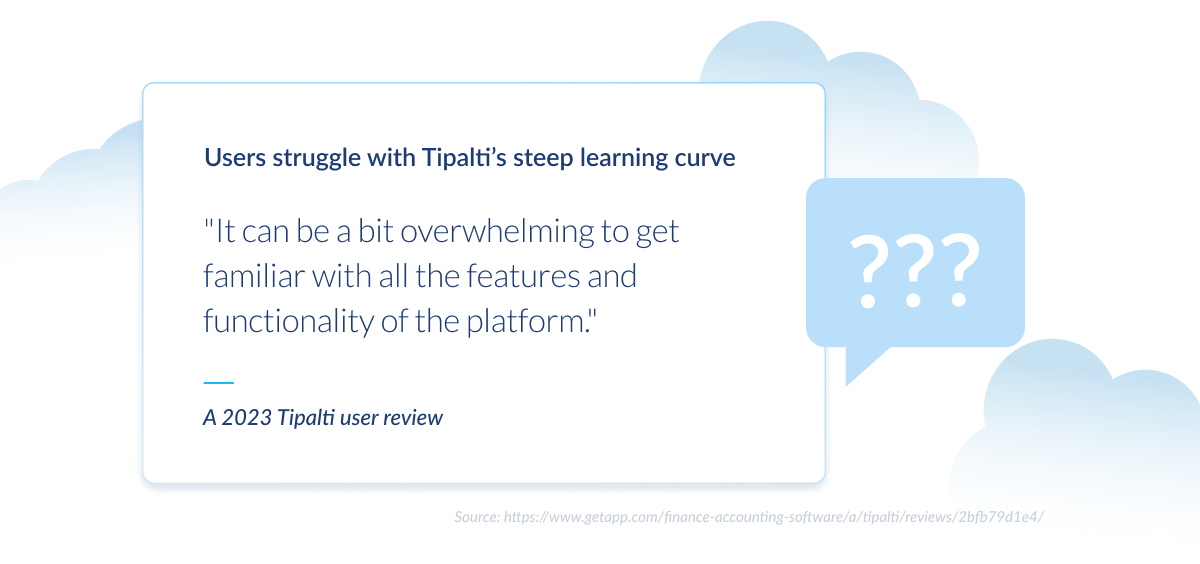
Customers consistently report difficulty navigating features, with one saying “it can take some time to understand all the functionalities and features available.” Another customer cites Tipalti’s steep learning curve as “[o]ne of the things that I liked the least,” adding, “it can be a bit overwhelming to get familiar with all the features and functionality of the platform.”
Stampli eliminates this complexity: With 99% customer satisfaction and unified P2P automation built on a single platform, Stampli delivers enterprise capabilities without the enterprise learning curve. Stampli customers say, “it makes the invoice process super easy, whether it is coding them, sending them to approvers, and paying them.”
Customer support with lengthy implementation reality
While many existing Tipalti customers praise their customer support team quality — with one user describing them as “always kind and attentive” — the implementation experience tells a different story.
Tipalti’s P2P implementations often extend well beyond promised timelines, particularly when deploying both procurement and AP modules. Companies frequently report 6-18 month implementations that require expensive consultants and significant process changes. One frustrated customer describes the Tipalti support experience as “terrible,” complaining that “Onboarding was incomplete and long,” and that it “takes weeks to resolve issues.”
Stampli’s implementation advantage: While Tipalti customers struggle with lengthy deployments, Stampli’s unified architecture enables implementations measured in weeks, not quarters. With 70+ pre-built ERP integrations and AI that adapts to existing workflows, most customers go live quickly.
“Customer support in this process has been outstanding,” says one customer about their Stampli P2P implementation experience.
Tipalti’s weaknesses
Here are the key challenges Tipalti customers identify with the platform.
Chronic ERP integration issues despite global capabilities
Despite Tipalti’s comprehensive features, many users report persistent difficulty integrating with ERPs and accounting systems — problems that persist even after implementation completion.
One customer left a strongly-worded review, “We had a ton of issues with our connection between Teampay/Tipalti/NetSuite. We were sold Tipalti and Teampay as a package deal, and they definitely have not lived up to the promise.”
More concerning, some organizations report connectivity issues persisting for years. One customer identifies chronic NetSuite synchronization problems as “the biggest drawback from my experience with Tipalti,” noting that Tipalti “constantly failed to sync billing PDFs with NetSuite which caused a lot of inconveniences.”
Stampli’s integration reliability: Unlike Tipalti’s integration struggles, Stampli offers 70+ ERP integrations with real-time two-way synchronization.
Users consistently praise Stampli’s connection reliability, saying it “provides a single source of receiving and processing ALL of our bills into one platform and syncing with NetSuite. We no longer have ‘exceptions’ with our complicated processes that a platform cannot handle.”
AI automation that lags behind purpose-built solutions
While Tipalti offers OCR and automation features, customers report inconsistent results that require significant manual intervention. The platform’s AI capabilities appear less mature compared to purpose-built solutions with deeper learning histories.
AI-first approach: Stampli’s AI employee Billy brings 83 million hours of procurement and AP experience, delivering 97-100% PO matching accuracy.
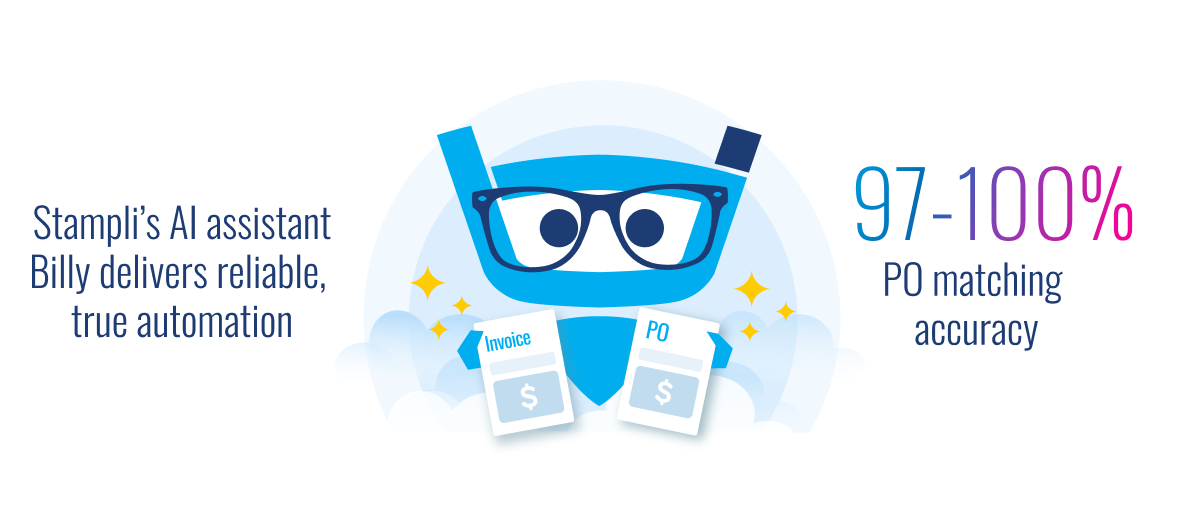
While Tipalti customers struggle with inconsistent optical character recognition (OCR), Billy helps finance teams structure purchase requests in plain English, auto-suggests general ledger (GL) coding based on historical patterns, and flags duplicate invoices with proven accuracy.
Implementation complexity that often exceeds timelines
Multiple customers report implementation cycles extending far beyond initial estimates, particularly for complete P2P workflow deployments.
One customer details their problematic experience: “We started out our implementation with one consultant who simply could not deliver. Every requirement we had was a question they needed to forward to their engineering team. This caused a delay of a full month on an implementation that was going to take 5 weeks.”
Stampli’s implementation reliability: While Tipalti implementations often stretch into quarters or longer, Stampli customers regularly deploy complete P2P functionality in weeks. “We were up and running within weeks of signing our contract,” says one Stampli customer. “The few times we’ve had to reach out to support, we are chatting with a real person within 1 minute. We integrate with NetSuite, and that works perfectly.”
Tipalti pricing
Tipalti implements monthly platform access fees combined with module-specific charges. The system requires advance funding of payment accounts before vendor disbursements, plus additional costs for expanded modules, advanced features, and specialized functionality.
Expenses accumulate as organizations layer on complexity they may not actually require.
The bottom line: Tipalti delivers global capabilities at the cost of simplicity
Tipalti’s comprehensive global payment processing makes it attractive for companies with truly complex international operations and regulatory compliance requirements. The platform excels when you need payment processing across 196 countries with extensive tax compliance and vendor management.
However, for most growing companies, Tipalti’s enterprise complexity creates more problems than it solves. Lengthy implementations, steep learning curves, and integration challenges suggest that unless you specifically need global payment processing at scale, you’re paying for complexity you don’t need while sacrificing the simplicity you do.
If you need enterprise P2P capabilities without enterprise complexity, Stampli delivers unified procurement and AP automation that adapts to your existing processes. With 99% customer satisfaction, implementations in weeks not months, and proven AI accuracy, you get the automation you need without the overhead you don’t.
One Stampli customer summarizes their experience: “My experience with Stampli has been excellent! They have provided answers to any questions that I have had and always give me solutions for any issues very quickly. They have superb customer service and the software is extremely user friendly!”
Ramp: The card-first approach with basic AP add-ons
Ramp burst onto the fintech scene as a corporate card provider promising to revolutionize business spending. While their card product gained traction with attractive cashback rewards (up to 1.5%) and slick expense tracking, their accounts payable capabilities tell a different story.
The reality: While enterprise suites can be too complex for mid-market needs, Ramp’s card-first approach with basic AP add-ons may be too simple for companies that need real P2P depth.
Stampli offers the “just right” solution — comprehensive P2P automation that’s sophisticated enough to handle complex workflows yet intuitive enough for rapid deployment and high user adoption.
Ramp key features
- Physical and virtual cards with 1-2% cashback rewards
- Real-time policy enforcement and spending limits
- Automated receipt capture and expense categorization
- Email invoice submission with basic OCR data extraction
- Reporting dashboard with real-time analytics
- Integrations with platforms including major ERPs primarily optimized for spend management workflows
Ramp’s strengths
Unified spend management for basic needs
Ramp consolidates expense management functions into one dashboard, offering visibility into spending patterns and cost control mechanisms that many finance teams find valuable.
Organizations with straightforward requirements benefit from having corporate cards, expense tracking, and basic invoice handling within a single interface. The platform delivers immediate spending insights, automated policy compliance, and attractive cashback benefits.
However, there’s a crucial distinction between consolidated spend tracking and integrated P2P automation. While Ramp excels at managing card-based transactions and basic expenses, Stampli creates seamless connections from initial purchase requests through final payment reconciliation. Instead of bolting AP functionality onto spend management, Stampli unifies the entire procurement-to-payment lifecycle in one purpose-built platform.
Stampli connects every dot: Purchase requests automatically flow into AP workflows, Billy learns from your organization’s spending patterns across the entire P2P cycle, and finance teams get complete visibility from commitment to cash impact. It’s not just transaction-level spend tracking.
As one Stampli customer explains, “Workflow is fantastic for AP as well procurement purchase requests and admin controls are great.”
Ramp’s weaknesses
AP automation as an afterthought, not a foundation
Ramp approaches invoice processing as a logical addition to their card business model. Their reasoning seems straightforward: if we’re already handling corporate spending, why not tackle vendor invoices too?
Unlike Stampli’s mature AP automation expertise, Ramp provides elementary capabilities suitable for organizations with minimal invoice processing requirements:
- Email invoice submission with basic OCR data extraction
- Simple approval workflows and payment scheduling
- Integration with spend management dashboard
- Basic consolidated reporting across all payment types
Customer feedback reveals a consistent pattern: While Ramp delivers excellent card and expense management, verified reviews highlight functionality gaps crucial for comprehensive P2P operations.
“It is not fully integrated into our SAP system, requiring additional work on our end to transfer work order numbers and service order tracking,” explains one customer in their review.
AP automation roots: Stampli began as a purpose-built platform for AP automation. Rather than working backwards from payments to tack on financial management features, we’ve specialized in complex workflows, approvals, routing, and system integration since day one.
Limited customization and workflow constraints
According to customer testimonials, Ramp can present many limitations with lack of customization and rigid workflows.
One review mentions “Ramp is streamlined and easy to use … [but] less flexible for complex approval chains, multi-entity setups, or unique accounting rules. Custom routing or nuanced workflows may require workarounds.”
Additional customer feedback highlights approval hierarchy limitations, with one reviewer noting the need for “the ability to have a review hierarchy” that Ramp’s current system doesn’t adequately support.
Stampli’s flexibility: Conversely, Stampli’s adaptive architecture molds to existing business processes rather than forcing universal standardization across diverse organizational needs.
ERP integration gaps
Though Ramp maintains many platform connections, their integration strategy falls short of Stampli’s 70+ ERP integrations optimized for real-time synchronization. Ramp’s systems typically update daily rather than providing the immediate data flow that Stampli enables for critical ERPs including NetSuite, Sage Intacct, and Microsoft Dynamics.
Built for your tech stack: Stampli’s purpose-built, internally developed integrations that maintain your current ERP configuration, Ramp’s connectivity may demand workarounds for sophisticated multi-entity environments or specialized data fields.
Reporting and navigation challenges
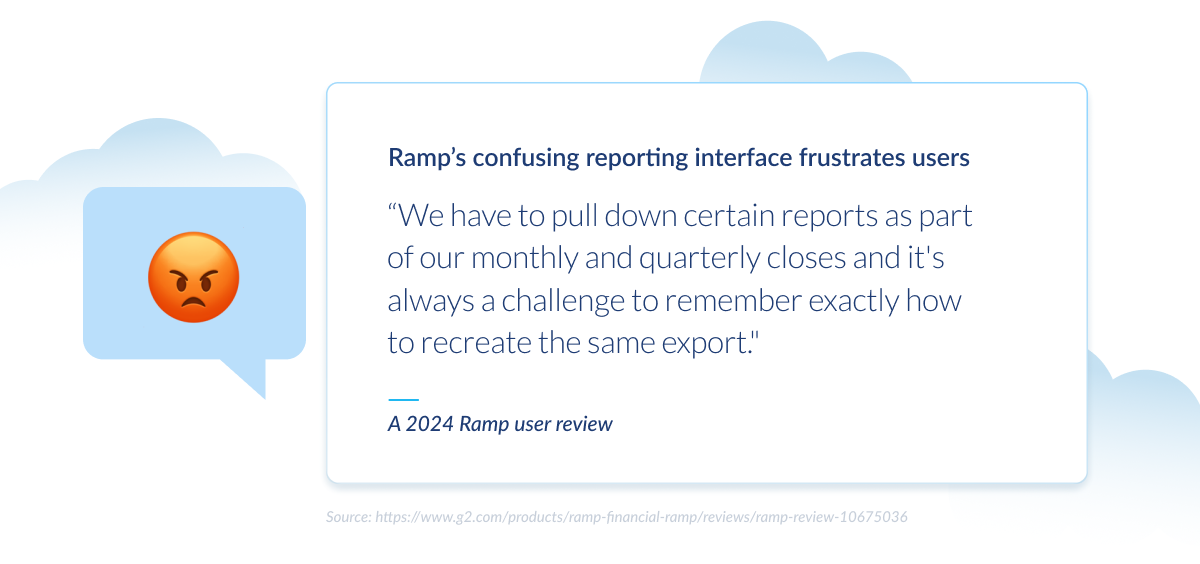
Customer feedback consistently identifies reporting challenges with Ramp.
One Ramp customer explains, “The reporting interfaces are oddly difficult to manage and navigate. We have to pull down certain reports as part of our monthly and quarterly closes and it’s always a challenge to remember exactly how to recreate the same export.”
Limited advanced features and AI capabilities
Customer reviews for Ramp identify missing essential business capabilities. One user notes there are “No travel portal or advanced approval workflows (yet),” while another mentions “the travel manager lacks a key feature we need before implementing.”
Deep AI expertise: While Ramp’s artificial intelligence represents newer market entry, Billy leverages 83 million hours of P2P experience and achieves 97-100% accuracy in purchase order matching.
The procurement blind spot
Ramp’s procurement management and P2P automation addresses basic requirements but reveals significant functionality gaps compared to Stampli’s holistic P2P methodology:
- Absence of systematic purchase order creation or lifecycle management
- Disconnected procurement approval and invoice processing workflows
- Informal employee purchase request channels persist
Ramp pricing
Ramp’s financial model fundamentally differs from traditional AP automation software because their revenue stems from corporate card interchange fees.
Understanding this economic structure proves essential when calculating total ownership costs and long-term strategic value.
Ramp structures three service levels:
- Starter plan: $0/monthly per user
- Growth plan: $15/monthly per user plus platform charges
- Enterprise plan: Customized pricing structure
Ramp’s economics function through card interchange revenue — the 2-3% merchants pay on every card transaction. This means “free” functionality gets subsidized through your card spending, and high-volume card users essentially pay more via increased transaction expenses.
Unlike Stampli’s transparent cost structure, this interchange model incentivizes card usage over alternative payment methods, potentially creating operational friction for organizations preferring diverse payment flexibility or requiring sophisticated AP automation beyond basic card-focused workflows.
The bottom line: Ramp meets basic needs, limiting for P2P growth
Ramp may suit specific organizational profiles:
- Companies emphasizing corporate card oversight over comprehensive AP automation depth
- Startups seeking rapid consolidation of basic spend management vendors
- Teams with extremely elementary AP processes avoiding advanced AI, deep ERP integration, or sophisticated approval workflow requirements
- Organizations accepting interchange fee-subsidized economics and card-focused payment methodologies
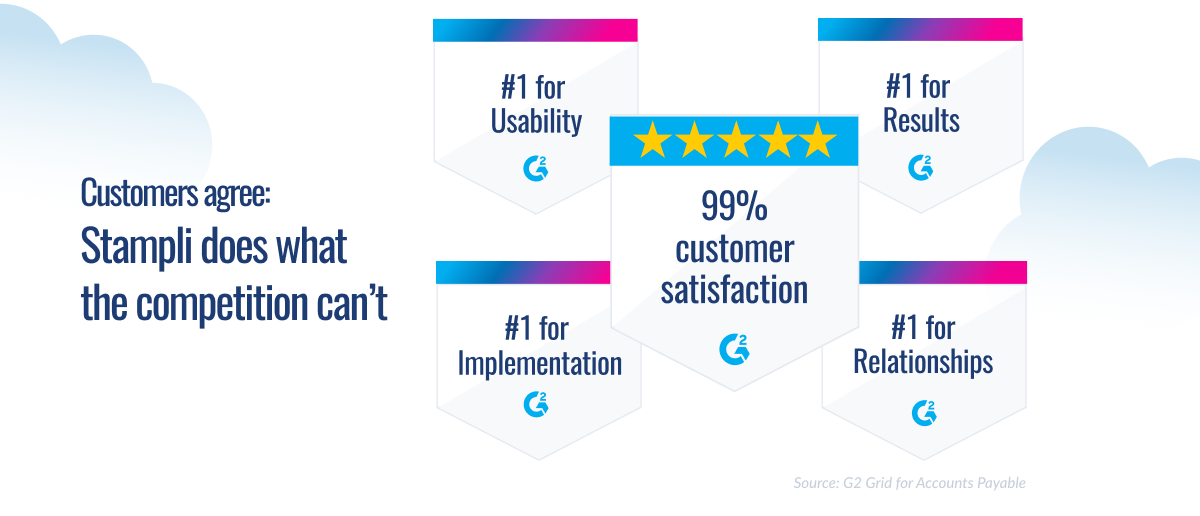
While Ramp has achieved solid adoption in the spend management space, their G2 satisfaction score of 82% reflects the limitations of their basic AP approach.
In contrast, Stampli consistently maintains a 99% customer satisfaction rate and ranks #1 across Implementation, Usability, Relationship, and Results indices in the G2 Grid for Accounts Payable.
Stampli: The P2P Platform That Delivers Perfect Balance
When enterprise procurement suites demand months-long implementations and basic AP tools leave critical gaps, finance leaders need a solution that hits the sweet spot.
Stampli represents the optimal equilibrium — sophisticated enough to handle complex multi-entity operations, yet nimble enough to deploy in weeks rather than quarters.
The Goldilocks solution for modern finance teams
Unlike heavyweight enterprise platforms that overwhelm mid-market organizations with unnecessary complexity, or lightweight tools that crumble under real-world demands, Stampli calibrates perfectly to your actual needs. The platform seamlessly bridges every stage of the purchasing lifecycle — from initial requisition through final reconciliation — without forcing your team to abandon proven workflows.
This balanced approach eliminates what Stampli calls “obscurement” — the visibility gaps and process breakdowns that plague fragmented systems. Instead of juggling multiple point solutions or wrestling with over-engineered enterprise suites, finance teams gain unified control over their entire spend ecosystem.
“Stampli has allowed our manual AP process to be automated…which is significant considering the incredible growth we are seeing in our company,” explains one customer. “It has allowed for greater control and insight into company expenditures as well as reporting features that have been useful for our CFO and CEO.”
Stampli key features
Stampli helps finance teams orchestrate complete procurement-to-payment operations through intelligent automation, streamlined invoice processing, sophisticated approval management, and integrated payment execution.
By unifying procurement workflows with accounts payable operations, the platform optimizes working capital management while providing finance leaders comprehensive spending visibility from requisition through reconciliation.
Stampli features include:
- Advanced procurement automation: An intuitive employee purchasing interface with smart request forms operated by Billy — your AI employee who structures requisitions, fills in missing details, and suggests routing based on policy and history. The system includes six standardized request templates (general purchasing, travel coordination, IT hardware, software acquisition, office supplies, and service requests) plus unlimited customizable request categories, all seamlessly integrated within Stampli’s full procure-to-pay (P2P) process.
- Dynamic fulfillment orchestration: Approved purchase requests generate multiple execution pathways — PO creation within your ERP, PO management through Stampli.
- AI-powered invoice capture and processing: Automated invoice data extraction leveraging OCR and artificial intelligence, smart coding and GL distribution based on historical data, plus configurable multi-tier approval workflows with comprehensive audit documentation.
- Sophisticated purchase order management: Two and three-way matching across POs, receipts, and invoices achieving up to 97-100% match precision, seamlessly managing partial receipts and split PO scenarios.
- Live budget oversight: Budget monitoring and control featuring real-time validation against spending thresholds, proactive alerts for over-budget requests, plus approval workflow integration displaying budget implications before authorization.
- Native integration with 70+ ERPs: NetSuite, Sage Intacct, SAP, Oracle, Microsoft Dynamics, and QuickBooks featuring real-time bidirectional data synchronization.
- Stampli Direct Pay: Integrated payment processing supporting ACH, wire transfers, checks, and virtual cards with international payment capabilities to 100+ countries plus foreign exchange management tools.
- Comprehensive vendor management: Structured vendor onboarding workflows, self-service vendor portal, integrated vendor messaging, plus centralized document collection and compliance monitoring.
Connect every dot: Complete P2P transformation
Tipalti customers battle handoff complications between procurement requests and invoice processing, creating visibility losses, duplicate data entry, and payment surprises.
Stampli eliminates process “obscurement” by connecting every step from initial purchase request through final payment within one integrated platform.
With Stampli’s P2P automation, identical records flow through approval, fulfillment, PO creation, invoice matching, and payment execution. No data transfers or process interruptions.
Customers say this complete vision aligns with the realities of modern finance. One customer explains it simply: “I like that Stampli understands businesses of today. Stampli offers so many flexible options for a business that has mostly remote workers.”
AI that actually works for finance teams
While competitors rush AI features to market, Stampli’s AI employee, Billy, has 83 million hours of AP experience.
This isn’t experimental technology – it’s battle-tested intelligence that has processed billions of transactions across thousands of organizations.
Billy transforms routine AP drudgery into automated precision:
- Cognitive invoice processing that understands context, not just data extraction
- Intelligent GL coding that learns your organization’s patterns and preferences
- Dynamic approval routing that adapts to your team structure and policies
- Predictive matching that achieves 97-100% accuracy in three-way PO reconciliation
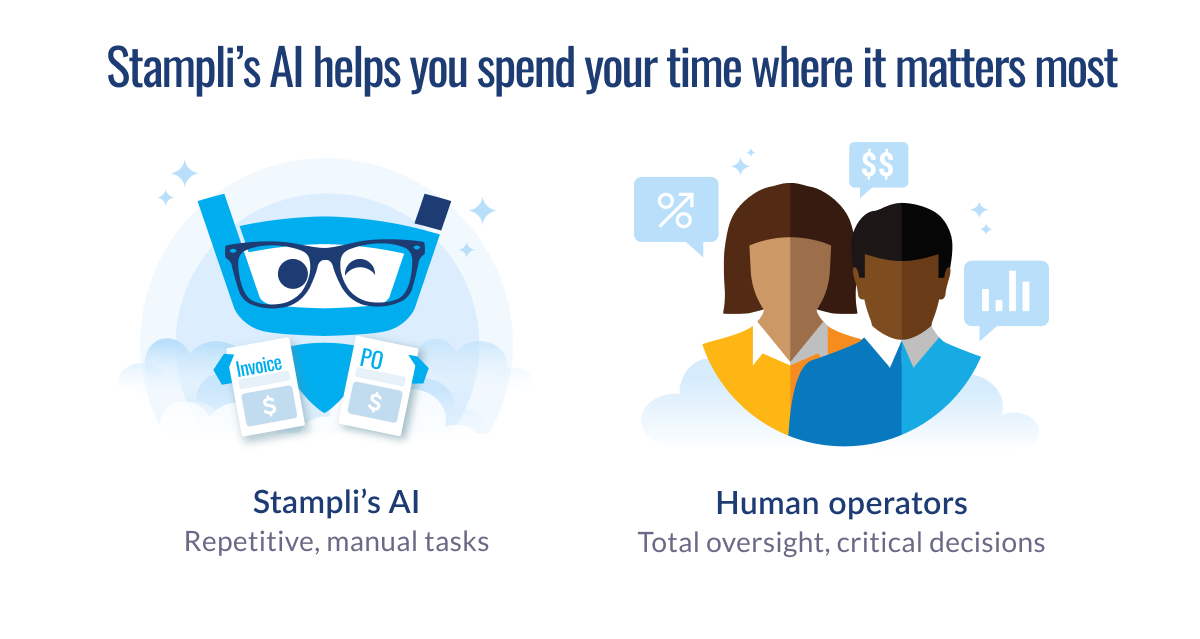
Customers report 75% faster invoice processing, which leads to faster month-end closes, freeing finance professionals to focus on strategic analysis rather than data entry.
Many customers report that Stampli’s AI features make their teams more efficient and strategic.
“Let the AI do the basic tasks, so the team can utilize their human ingenuity,” says Matt Andersen, CFO of Superior Masonry Unlimited. “Stampli has given my team and I the ability to focus on the bigger strategic mission.”
Integration excellence: 70+ ERPs, zero disruption
Stampli’s integration philosophy centers on adaptation, not forced transformation.
With pre-built connectors to 70+ ERP systems — from NetSuite and SAP to industry-specific platforms — the system molds around your existing financial architecture rather than demanding costly reconfigurations.
This comprehensive connectivity delivers:
- Real-time bidirectional sync that keeps Stampli and your ERP perfectly aligned
- Preservation of custom fields and organizational hierarchies you’ve already established
- Multi-entity support for complex corporate structures without additional complexity
- Lightning-fast deployment that typically completes in days or weeks, not months
Fast deployment and time to value
Enterprise-focused suites demand 6-18 month implementation cycles with expensive consulting resources and disruptive process modifications. Meanwhile, even “simpler” alternatives like Tipalti often still experience extended implementation cycles.
But your team needs faster value realization without the complexity.
Stampli maps current workflows and enhances existing processes rather than demanding complete process overhauls. With pre-built ERP integrations supporting comprehensive native functionality, most Stampli customers achieve go-live status in days or weeks.
Multiple Stampli customers have experienced this streamlined setup directly. “Stampli integration was efficiently completed within a day,” reports one customer, “and we were able to implement the new processes within less than a week.”
Industry-leading customer support that’s always on your side
P2P implementations involve complexity, and even with excellent technology, challenges emerge. Customers report that other platforms offer lacking or unrespective support, particularly for complex technical issues.
Stampli’s entire support organization consists of P2P and ERP experts with direct financial operations experience. This provides deep insight into each customer’s unique challenges plus the expertise to resolve them quickly.
“Customer Service is always there,” says one Stampli customer in the healthcare industry. “When we implemented a new ERP, they were there immediately and dedicated throughout the process.”
Customer satisfaction speaks volumes
As the leading P2P automation platform, Stampli consistently maintains a 99% customer satisfaction rate while processing over $90 billion in annual organizational spend.
It’s won plenty of awards, too:
- G2 Best Software Products for 2024: Best Accounting & Finance Software
- G2 Grid Leader for AP Software: #1 for Highest User Satisfaction
- TrustRadius: #1 for Accounts Payable Software and Top Rated solution
“Stampli Has Brought Great Structure to My Team!” celebrates one customer. “Before using Stampli, the invoice management process lacked collaboration between all parties involved in reviewing and approving just 1 invoice. Stampli has provided structure, ease & teamwork since day 1!”
Stampli pricing
Unlike competitors who rely on interchange fees or per-transaction charges, Stampli uses transparent subscription pricing that aligns with your business goals, not payment method preferences.
Stampli’s straightforward approach includes:
- Simple subscription model: Monthly or annual plans with no hidden transaction fees
- Unlimited users and vendors:Scale collaboration and supplier networks without cost penalties
- Comprehensive training included: Full onboarding and ongoing education for your entire team
The key difference: Stampli doesn’t profit from pushing specific payment methods or transaction volumes. Stampli’s vendor-neutral pricing lets you optimize payment strategy based on your treasury objectives, not the financial incentives of your software vendor.
This reflects Stampli’s comprehensive platform approach — you invest in a complete solution that eliminates multiple point solutions and their associated implementation, integration, and maintenance costs.
The bottom line: Stampli delivers on the promise of P2P automation
Stampli represents the sweet spot that growing finance teams have been seeking.
Enterprise-grade automation capabilities without enterprise-level complexity burdens.
While Tipalti customers navigate 6-18 month deployment cycles and Ramp users hit functionality walls as they scale, Stampli molds around your existing processes rather than demanding costly reconfigurations.
Stampli eliminates the trade-offs that plague other solutions.
Stampli also solves fragmented spend visibility across multiple systems. From initial purchase request through final payment reconciliation, every transaction flows through unified workflows with complete audit trails. No data handoffs, no process gaps, no surprises.
For finance teams ready to move beyond basic tools but unwilling to accept enterprise complexity, Stampli provides the “just right” solution. You gain sophisticated automation that scales with your business growth, not against it, paired with the intuitive usability that drives genuine adoption across your entire organization.
Choosing to P2P solution for you
Now it’s time for an honest assessment of your needs and which platform will best support your goals and growth.
Tipalti may be the right choice if you’re managing genuinely complex international operations with extensive regulatory compliance requirements across 50+ countries. Their platform is particularly suited to process high-volume mass payments with sophisticated multi-currency and tax compliance needs.
Just keep in mind that you’ll need dedicated resources for 6-18 month implementation cycles and extensive user training programs. And you’ll need to consider compatibility with an enterprise-grade global payment infrastructure that can absorb the associated operational complexity.
On the other end of the spectrum, Ramp could be a fit for organizations that need to prioritize corporate card management and basic expense tracking over comprehensive AP automation.
Especially if you process fewer than 100 invoices monthly with straightforward approval workflows. In that case, the cost-free entry point and interchange fee-subsidized pricing will be appealing, especially if you are comfortable with relying primarily on card payments.
Consider the short- and medium-term needs of your org, though. It’s possible you will quickly outgrow the capabilities of Ramp or be stuck with fragmented systems not built to operate as a unified platform.
Finally: Stampli.
Choose Stampli if you need enterprise-grade P2P automation without enterprise-level complexity and deployment timelines.
If you’re processing a growing volume of invoices (100+ monthly) and require sophisticated workflow customization plus want AI-powered automation that adapts to your existing processes rather than forcing wholesale changes.
It’s also a great fit if you require seamless ERP integration with real-time synchronization and minimal IT involvement.
Most growing organizations find themselves in Stampli’s sweet spot — needing more sophistication than basic tools provide, but wanting to avoid the complexity and resource requirements of traditional enterprise suites. If you’re processing increasing invoice volumes while maintaining lean finance teams, Stampli’s adaptive approach typically delivers the optimal balance of automation depth and implementation simplicity.
Ready to transform your P2P operations?
Don’t let manual processes and disconnected systems hold your finance team back. While your competitors struggle with complex enterprise implementations or hit limitations with basic tools, you can achieve the perfect balance of automation sophistication and operational agility.
Discover why finance teams at thousands of growing organizations choose Stampli.
Schedule your personalized demo today and discover how Stampli’s “just right” approach can transform your procurement-to-payment operations without the complexity headaches or extended timelines of traditional solutions.
