




How to control expenses in your business
Are you keeping business expenses under control?
Businesses that lose sight of how spending affects revenue are putting themselves at risk. In today’s hyper-competitive market, businesses that keep their costs low earn the highest profits.
Cost control is the process of identifying, reducing, or eliminating wasteful spending and inefficient expense management processes to reduce costs and grow profits. Although you can reduce business expenses in the short term by cutting unnecessary expenses, making structural improvements to your ability to track, manage, and control your spending should be a top priority.
Read on to learn the basics of cost control, how to track and categorize spending, and how to leverage automation technology and payment cards to improve financial planning and control expenses.
What Is cost control and why is it important?
Starting a business is common; sustaining it is harder. The U.S. Census Bureau’s Business Formation Statistics tracks business applications and formations over time, while Bureau of Labor Statistics data follows how establishment survival changes as firms age.
The latest BLS establishment survival table reinforces a practical point for owners and finance leaders: cash discipline and expense control matter throughout a company’s life, not only during a downturn.
Cost control is important because it lets businesses reduce expenses by analyzing and tracking variances between budgets and actual costs. If actual costs are higher than budgeted, financial leaders have the information they need to identify and address the variance.
Companies that practice effective cost control have several competitive advantages.
- Improved business performance: Managing costs through regular cost analysis, optimization practices, and automated spend management tools improves profitability and cash flow.
- Project cost management: Building cost control into project management policies enables managers to quickly identify and address cost overruns before they spiral out of control.
- Stronger vendor relationships: Greater visibility into supplier costs and improved AP processes help businesses reduce vendor disputes, get vendors paid on time, and negotiate better supply contracts.
- Improves working capital: Predictable monthly costs mean predictable cash flow, freeing up working capital and reducing the need for emergency financing.
The expense management process starts with a realistic budget. It looks at how much money a business expects to spend, how much it’s actually spending, and what it’s spending it on. Although each company’s budgeting process is different, the fundamental cost control process is similar.
Understanding cost control
Basic cost control includes two methods to determine cost targets: target net income and variance analysis.
Target Net Income
Target net income is the expected business income after taxes for a specific accounting period. It provides a yardstick to estimate budgeted expenses to produce a target profit.
The formula for target net income is:
Target net income = revenue, variable expenses, fixed expenses
Assuming revenue is fixed (set by leadership), reaching target net income means reducing fixed and variable costs for the period.
For example, assume a construction company wants to earn $3 million in income from $30 million in project revenue for the quarter. To hit their target net income, they need to structure the company’s spending to keep expenses for the quarter under $27 million.
Also, they need to analyze variances between budgeted and actual expenses each month. By drilling into monthly expenses, they can identify and address overspending and unexpected costs and keep the company on target for the quarter.
Variance analysis
A financial variance occurs when there’s a difference between a budgeted and actual result during an accounting period. Favorable variances are when actual costs are below budget, and unfavorable variances are when actual costs exceed the budget. Companies can use variance analysis to identify variances, determine what’s causing them, and take corrective action.
Using our construction company example, say the company sets a budget of $1 million in variable costs and $2 million in fixed costs. At the end of the first month, variance analysis reveals that actual variable expenses are $100,000 higher than budgeted for the month, a significant negative variance. Using this information, the company can identify the categories with cost overruns and take action to address the variance by reducing spending.
Cost control gives businesses the methods and tools to identify and determine cost overruns. Informed by cost control data, businesses can change spending to control expenses. It’s helpful to think of cost control as the big picture and expense control as the changes to spending habits needed to keep the business on track.
Let’s take a closer look at how your business can take control of its expenses.
How expense control works
Businesses incur expenses for operations and making sales. Controlling expenses involves managing how a business spends money by reducing expenditures, improving operational efficiency, optimizing supplier relationships, and controlling employee expenses.
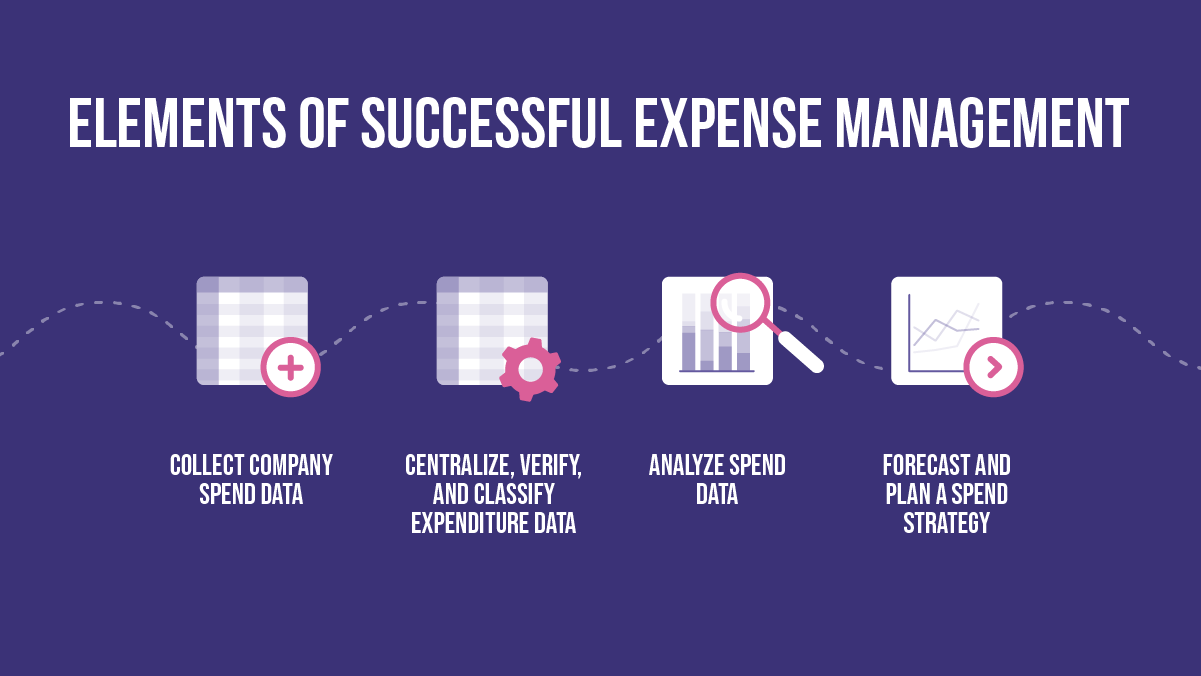
A modern spend management strategy involves three functions:
- Identifying, categorizing, and tracking expenses.
- Improving spend management efficiency with automation.
- Controlling and reducing operational costs.
Let’s break these out.
Identifying, categorizing, and tracking expenses
You need to know where your money is going before you can control how you spend it.
Group related expenses into expense categories to make it easier to identify and manage controllable expenses. Identify the categories your business uses the most and will need in the future as the business grows. For example, businesses usually group employee entertainment and travel expenses into the travel & entertainment category.
You can break expenses into three main categories:
- Fixed expenses: Recurring expenses like rent, insurance premiums, property taxes, and equipment lease payments that don’t change, or change very little, in the future.
- Variable expenses: Expenses like utilities, communications, or payroll that can change from month to month or season to season.
- Periodic expenses: Incidental expenses like vehicle repairs, travel, or office supplies that a business incurs occasionally.
To make tracking and controlling expenses for specific projects or products easier, break the spending categories into direct and indirect expenses.
- Direct expenses: Expenses involved with the production of a specific product or service, like labor, raw materials, or equipment.
- Indirect expenses: Overhead expenses necessary for daily operations, like office rental, employee benefits, and legal costs.
Assign each expense category a general ledger (GL) code to facilitate accurate expense recording, reporting, and tracking. Record new expenses under the appropriate GL code for their expense category.
After you identify and categorize your expenses and begin tracking them, you’ll have visibility into how your company spends money. Next, we’ll talk about how you can leverage financial automation technology to improve spend management efficiency.
Use automation to get more control over expenses
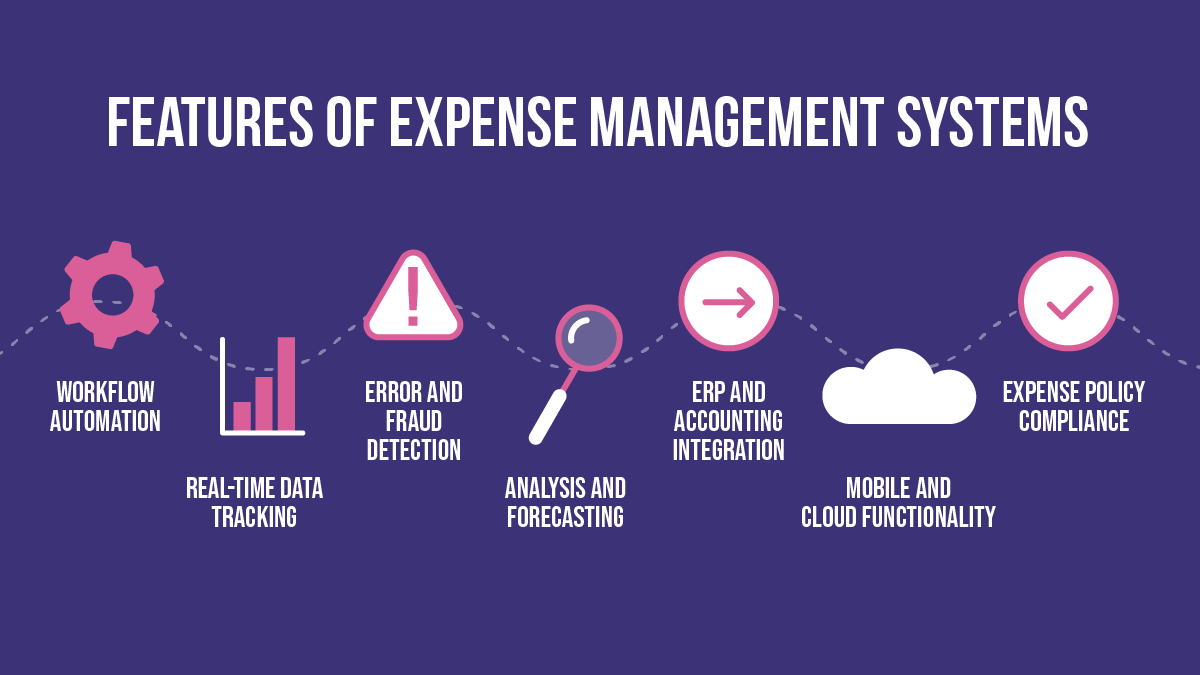
As you go through the process of categorizing company expenses, you’ll identify areas where you can reduce spending or improve process efficiency. However, addressing these areas with slow and error-prone manual accounting processes may be difficult. For example, manually checking every invoice and B2B payment to identify overspending can tie up already busy AP team members. Accounting automation solutions streamline spend management workflows by automating manual processes and providing real-time data tracking and transparency, giving you greater control over expenses.
We’re going to look at four technologies that can help you control business costs:
- Accounting software and ERPs.
- Accounts Payable automation and Spend Management.
- Employee expense management solutions.
- Credit card platforms.
Accounting software and ERPs
Accounting software and enterprise resource planning (ERP) platforms streamline basic accounting functions like budgeting, record keeping, categorizing expenses, reconciliations, and reporting. These systems have built-in variance analysis capabilities to let you compare actual spending by category with your budget. They also connect to your bank accounts to facilitate faster reconciliation and reporting.
Accounting platforms give near real-time visibility into how much money a business is spending and what it’s spending it on. However, they don’t always have the ability to manage vendor invoices or employee expenses. You may need to add a third-party automation solution to get this functionality.
Accounts Payable automation
Implementing an AP automation solution can improve visibility and control over vendor spending, reduce manual data entry, and support stronger supplier relationships. AP automation can capture invoice data, route approvals, manage exceptions, prepare transactions for ERP posting, and support payment readiness while finance remains in control of review and approval.
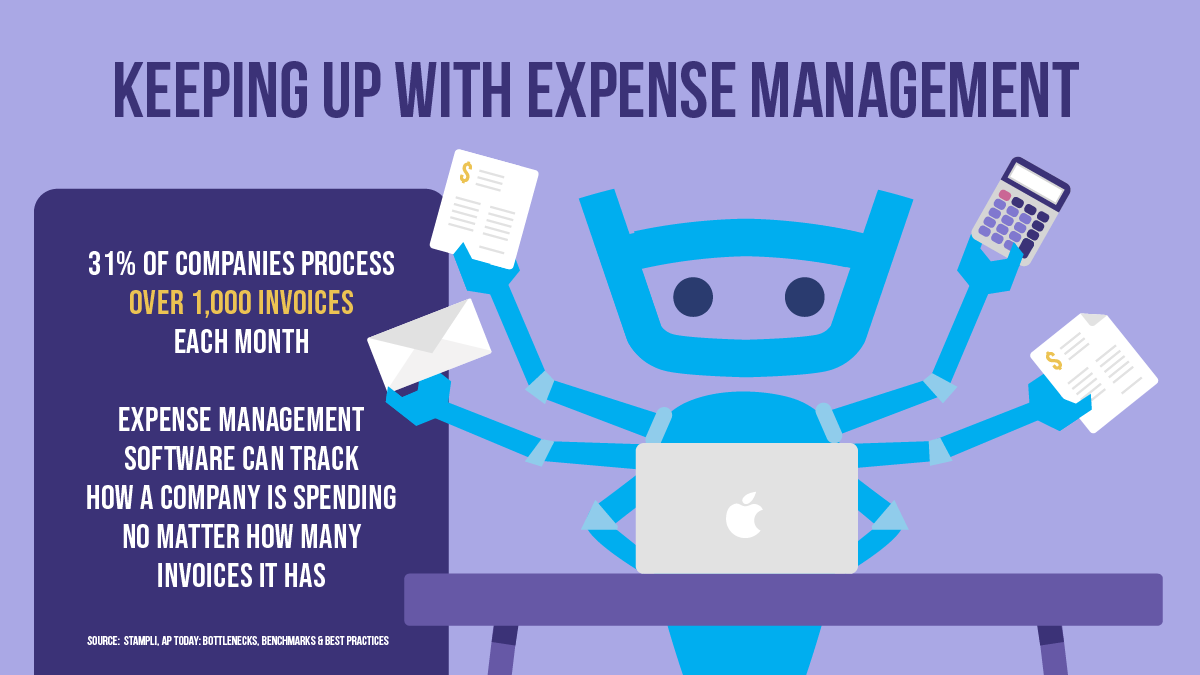
AP automation solutions like Stampli also offer live AP dashboards and reports that provide real-time insights into spending and AP process efficiency. These tools let businesses drill down into expense data when they need to know more about spending patterns.
Employee Expense Management Software
Employee expense management software helps businesses control two kinds of employee spend: company-card transactions after the swipe and employee-paid reimbursements before reimbursement money moves.
Employees can submit receipts, out-of-pocket purchases, mileage, and per diem. The workflow can apply policy checks, route approvals, suggest coding, and flag missing receipts or possible duplicate and card overlap for review. Finance can then complete AP Review, prepare approved reimbursements for payroll processing, and prepare reviewed card expenses for ERP posting and reconciliation.
Credit card platforms
Credit card solutions are evolving into a powerful spend management tool. Evolutionary virtual card solutions, like Stampli Card, give businesses exceptional visibility and control over expenses by integrating with AP automation solutions. This lets businesses leverage the AP solution’s capabilities for an extra level of customized spend control and data management.
Businesses can use credit cards to centralize employee and accounts payable spending to a single payment method. Bringing business expenses together in one place makes tracking and controlling them easier.
Credit cards also allow businesses to control employee spending directly. Some card solutions let businesses restrict cards by spending limit, merchant category code (MCC), department, or vendor. Transaction visibility can help finance spot unusual purchases, missing receipts, or shadow spend and route them for review.
Choose Stampli to Take Control of Your Business Expenses
Stampli brings procurement, accounts payable, payments, vendor management, and employee spend into ERP-integrated procure-to-pay workflows. The ERP stays the system of record, and finance keeps human review and approval in control.
For employee spend, Stampli Expense Management connects company-card expenses and employee-paid reimbursements. Employees get a practical way to submit receipts and details, while finance gets policy context, approval routing, coding suggestions, AP Review, reporting, payroll readiness, ERP alignment, and an audit trail.
The bottom line: controlling expenses takes more than cutting costs. It takes clear policy, timely documentation, appropriate spend controls, reviewable approvals, and reporting that shows finance what needs attention. Contact Stampli for a demo.
